
Reputation Management Agency: Services and How to Choose
What a reputation management agency does, what each service delivers, what it costs, and how to vet one on written scope, compliance controls and monthly measures.
You’ve just searched your own business the way a customer would. The hours are wrong on one listing, a two star review from last month sits unanswered, and an AI answer names a competitor for a service you also offer. Nothing catastrophic has happened, but the picture doesn’t match the business you run, and you don’t have spare hours to chase every site yourself.
That’s usually the moment owners start shopping for a reputation management agency. The sales calls sound reassuring, and they often centre on star ratings. Stars matter, but they’re the result of underlying work, not the work itself. You’ll choose better if you judge agencies by the scope, compliance controls and monthly measures they commit to in writing, because those are the parts an agency can control and the parts you can check.
What a Reputation Management Agency Does
Say you’re choosing between two restaurants in an unfamiliar town. One has no reviews at all. The other shows 4.8 stars from 127 recent reviews, with photos, correct hours and replies from the owner. Most diners pick the second place before they’ve read a menu. That choice isn’t really about food yet. It’s about the evidence available at the moment of decision.
Your business has a similar shop window, except it isn’t glass. It’s made of reviews, directory listings, search results and AI generated answers, and prospective customers inspect it before they call, book or walk in. A reputation management agency is a team that watches what those surfaces say about you, then acts on what it finds.
The Three Parts of the Work
- Monitoring: tracking new reviews, listing changes, mentions and search or AI answers so problems surface early.
- Acting: correcting inaccurate facts, replying to feedback, asking eligible customers for reviews and publishing evidence people can verify.
- Measuring: reporting whether ratings, response coverage and enquiries are improving, and where they aren’t.
Two kinds of action often get confused. Reputation repair corrects false information and answers real problems. Content creation publishes accurate material, such as service pages, photos and profiles, that customers and search systems can check. Repair without new evidence leaves a thin record. Content that contradicts your listings creates fresh doubt.
This is now a sizeable service category, and buyers still pay mainly for people. A Mordor Intelligence market estimate reports that services represented 64.90% of the market in 2025. Software can flag a review in minutes, but a person still has to judge whether it’s genuine, what reply is safe and whether it points to a recurring service fault.
A good agency doesn’t just make the score look better. It fixes the causes that produced the score.
Some agencies fix causes. Others polish the number and leave the wrong phone number, the unanswered complaint and the operational fault untouched. Everything that follows is a way to tell those two apart before you sign.
Core Services and What Each One Delivers
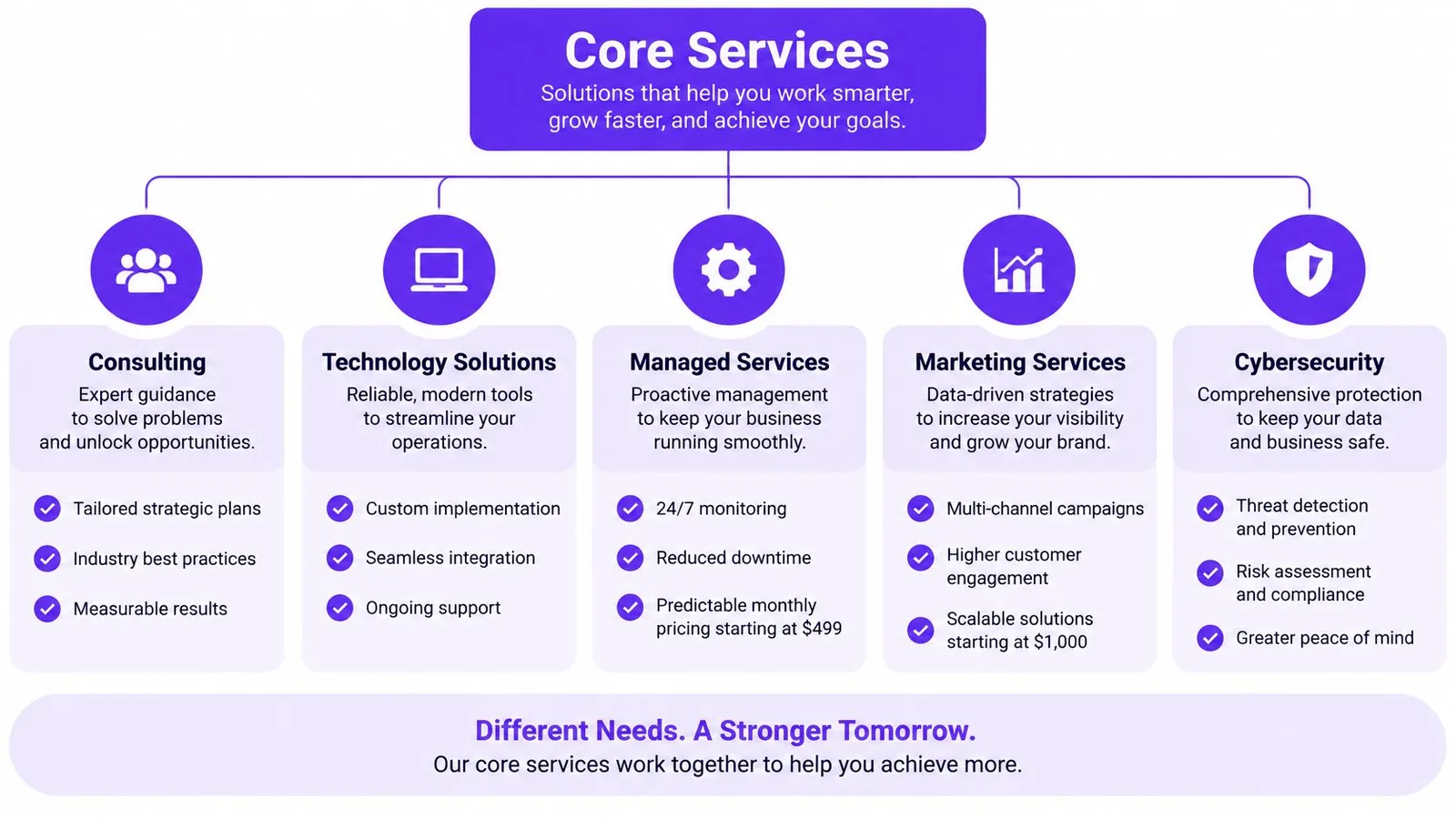
A proposal line that says “reputation management” can hide three different jobs: watching reviews, asking for reviews, and fixing the facts reviews point to. Read it like a menu heading, then ask what arrives on the plate. The useful unit is the deliverable: the log, audit, template, published page or report you can inspect each month.
Reputation management services and their deliverables
| Service | What It Covers | What You Receive | Ask Before Signing |
|---|---|---|---|
| Review monitoring and response | Tracks new reviews on Google and industry sites and drafts replies for approval | Alert log, reply queue and monthly rating report | Who approves replies, the target response time and what gets escalated |
| Review generation | Asks eligible customers for feedback after completed jobs | Request templates, sending schedule and request log | What triggers a request, who counts as eligible and what records prove every eligible customer was asked |
| Listings and citation cleanup | Corrects name, address, phone number and hours across directories | Citation audit, error list and correction status | Which directories are covered and how often corrected listings are re-checked |
| Search results management | Publishes accurate pages and profiles that appear for the brand name | Content plan, published assets and sign-off record | Whether claims are verifiable and who approves the facts before publication |
| Unfair content removal | Requests removal of false, defamatory or impersonating listings | Removal requests and status log | What outcomes are realistic, since removal is never guaranteed |
| Crisis response | Prepares holding statements and escalates serious allegations | Response plan, holding statement and escalation path | Hours of availability, who gets called first and which allegations trigger escalation |
| AI answer checks | Tests what search and AI tools say about the business | Baseline report of AI answers and their sources, plus a retest log | How often answers are re-tested and which corrections are attempted |
Two Services Buyers Often Confuse
Review monitoring and response is reactive. Someone reads incoming feedback, drafts a reply, gets your approval and posts it. Review generation is proactive. It asks eligible customers, after a completed job or appointment, to leave honest feedback, usually through a Google review link, and it records who was asked and when. Monitoring tells you what arrived. Generation changes the sample by asking consistently instead of hoping happy customers volunteer.
Listings work is less visible but just as practical. If your hours differ across Google, Apple Maps and industry directories, customers and AI tools have to guess which version is right. A citation audit gives you the error list, so you can confirm corrections instead of trusting a claim that cleanup is done. The same logic applies to AI answer checks: the value is not the first test, but the retest log that shows whether wrong answers are being corrected.
Providers package these pieces differently. Dekodi, for example, describes Reputation Management as monitoring, protecting and enhancing a client’s online reviews and brand image, while its Local Authority Builder lists a business on key directories and strengthens local search visibility. Whichever provider you consider, confirm which rows are included in the fee, which are add-ons, which compliance controls govern review requests and which measures are reported every month. Gaps usually appear after the contract starts, when a service you assumed was covered turns out to be extra.
Vet the Agency and Keep Reviews Compliant
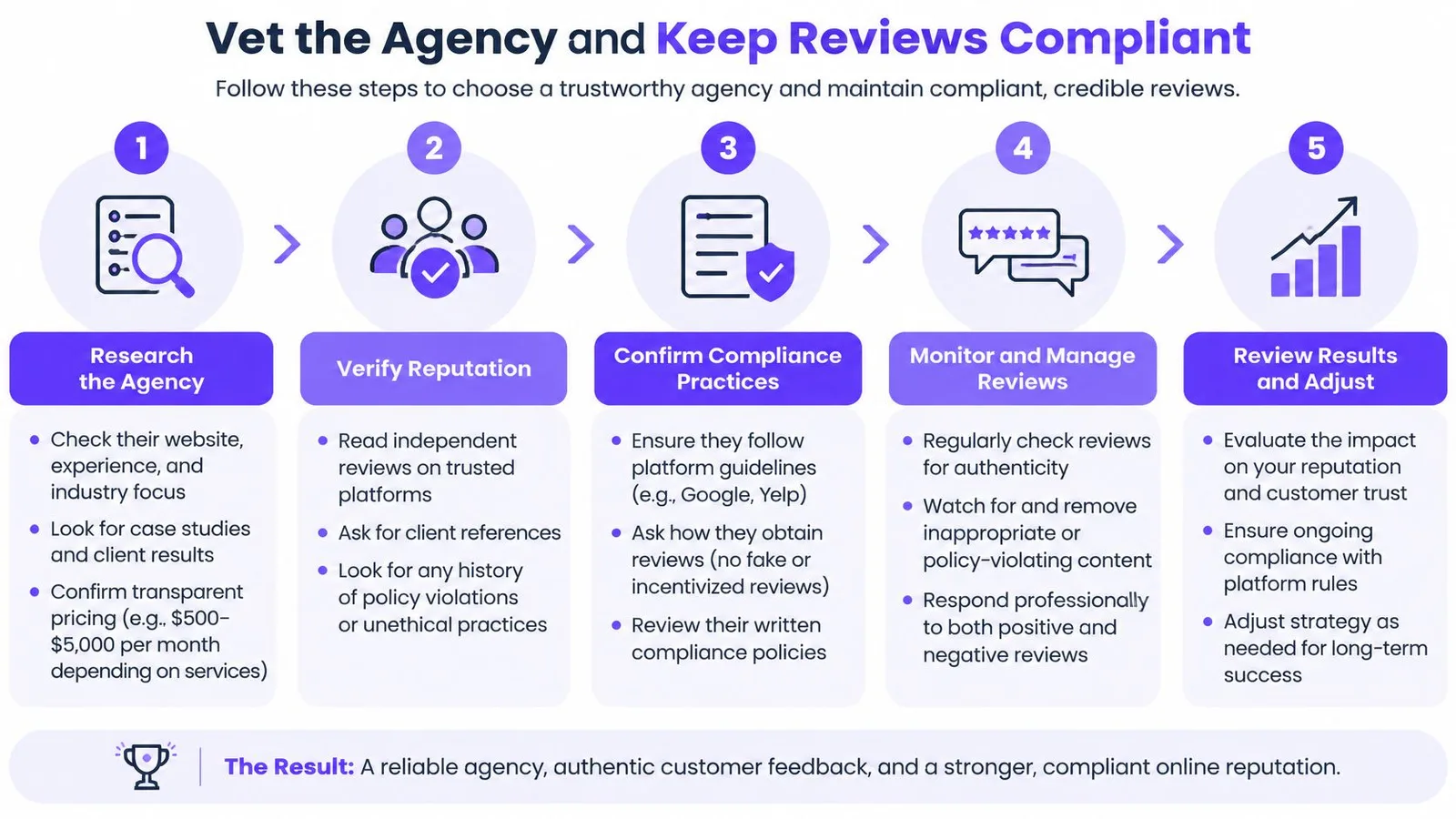
A strong agency survives vetting because it can prove what it claims. Your job is to collect the proof in documents, so proposals sit side by side for an honest comparison. The visual summary below shows the order to work through.
-
Start with a baseline audit. Ask each agency to audit your current reviews, listings and search results before proposing work. (You can run a quick web reputation check yourself first.) Without a fixed starting point, later reports can claim progress you can’t verify. A common slip is accepting a proposal built only on your star average, with no record of listing errors or unanswered reviews.
-
Get one written scope. It should list services, deliverables, response times and exclusions in a single document. Verbal promises rarely survive into a contract, and exclusions are where surprises hide. If crisis help matters, the scope should state availability hours and who gets called first.
-
Interrogate the review request process. Ask what triggers a request, whether every eligible customer is asked rather than only satisfied ones, and what records prove it. This is a legal question, not just a marketing one. The FTC announcement of the Consumer Reviews and Testimonials Rule describes a rule that is effective October 21, 2024 and prohibits fake reviews, buying reviews tied to a required sentiment, undisclosed insider testimonials and certain review suppression practices. Ask the agency to show its compliance control layer, meaning auditable consent and provenance records that identify the customer or transaction behind each request and preserve the request and delivery timestamp.
The stakes aren’t theoretical, and the short video below is a useful prompt for questions to raise with any provider.
-
Price the risk. An FTC warning to 10 companies in December 2025 underlines active enforcement, and violations can bring civil penalties of up to $53,088 per violation. So confirm three controls in writing. Incentives are never conditioned on positive sentiment. AI tools may draft replies for human approval but never invent customer experiences. Negative feedback goes to service recovery without blocking the customer from posting a public review.
-
Demand a sample monthly report. It should show response time, rating trend by location and conversion data, not only the overall star average. If you can’t act on the sample, the actual report won’t help either. Ask how recurring complaints are grouped, because that’s where operational fixes come from.
-
Meet the people and check references. Ask who drafts replies, who approves them and who is accountable when something goes wrong. Request references in your category, since a dental practice and a roofing firm face different review platforms and risks. Require written escalation rules for extortion attempts, impersonation, defamatory claims and genuine service failures, because each needs a different response and none should be improvised.
-
Protect ownership and compare total cost. Confirm you keep admin access to your listings and review profiles, and that you can export your review history if you leave. Then compare the full price, not just the monthly fee. Dekodi, for instance, bills premium tools and ad spend separately from its packages, so ask every candidate to state the equivalent items in dollars before you sign.
Practical rule: if an agency guarantees a score but won’t put deliverables, response times and compliance controls in writing, it’s selling the outcome while avoiding the work.
A representative review profile beats a selectively positive one. It’s safer legally, and it tells you what’s going wrong in the business.
Measuring Results Without Chasing Stars
A single star average can improve while the business gets no busier. To avoid that trap, treat reputation as a small set of measures you review together each month.
Reputation metrics a monthly report should include
| Metric | What It Tells You | Healthy Direction | Check By |
|---|---|---|---|
| Average rating | Overall sentiment toward the business | Rising over three months, not a single short-term peak | Location and service line |
| Review count | Volume of authentic reviews from verified customers | Steady growth from completed jobs | Location |
| Rating distribution | Whether low ratings cluster around one problem | Fewer one-star reviews repeating the same complaint | Service line |
| Response rate | Share of reviews that receive a reply | Near-complete coverage | Location and platform |
| Response latency | How quickly replies are posted | Consistent within the agreed window, such as two business days | Location |
| Conversion by source | Whether review traffic produces calls, bookings or inquiries | Rising share of calls and bookings from review-driven visits | Source and location |
Why Segmentation Matters
Always split these numbers by location and service line. A strong group average can hide a weak branch where one receptionist, one technician or one booking process generates most complaints. It can also hide a high value service that’s underperforming while routine, low value work earns easy praise. You can’t fix a problem you can’t locate.
There’s a pattern behind pairing sentiment with volume. The academic study of online customer reviews finds that sentiment has the strongest effect when ratings are very low or very high, while review volume becomes more influential once sentiment reaches at least a moderate level and positive sentiment links most strongly to purchase when consumers read many reviews for a relatively expensive offering. In plain terms, fix the cause of poor sentiment first, then grow volume. For dentists, law firms and home services, detailed and experience specific reviews carry extra weight because customers read closely before committing.
So the benchmark isn’t more five star reviews alone. It’s credible, sustained sentiment, growing volume from verified customers, and evidence that review exposure produces calls, bookings or qualified inquiries.
Use a simple diagnostic when numbers disagree. If your rating rises but calls don’t, your reviews may not be reaching people who are ready to book, or they may sit on a platform your buyers rarely use. If volume rises and sentiment falls, slow down requests and fix the service fault first. Expect a baseline in the first week and the first reliable trend after three months of data.
What Agencies Charge and What Each Model Covers
Pricing model matters as much as price level, because each model decides who does the ongoing work and who carries the risk.
Reputation agency billing models compared
| Pricing Model | How You Pay | Best Fit | Main Risk |
|---|---|---|---|
| Monthly retainer | Fixed monthly fee for monitoring, replies and reporting | Single-location businesses that need steady coverage | Paying through quiet months without clear deliverables |
| Project fee | One-time fee for an audit, cleanup or launch | Fixing a specific listing problem or a one-off crisis | Problems return without ongoing maintenance |
| Per-location fee | Monthly fee for each site | Multi-location brands | Costs scale quickly unless reporting is standardized |
| Bundled plan | One fee covering web, listings, reviews and content | Owners who want one accountable vendor | Weak components can hide inside a strong bundle |
| Software plus service | Platform subscription with human support | Teams with in-house staff who will run the work | The agency role stays narrow and your team carries the workload |
| Performance-based fee | Fee tied to ranking or rating outcomes | Rarely the right choice for reputation work | Pressure to chase outcomes that can breach platform or legal rules |
Headline Fee Versus Total Cost
Your real cost is the headline fee plus anything billed separately. In our own packages, for example, premium tools and ad spend are billed separately from the Digital Engine and Signature Build packages, and add ons are available for both. The Signature Build is a concrete illustration of project pricing at a one-time price of $8,199. Whatever the provider, ask for every separate charge in one list before comparing quotes.
Consider a hypothetical choice. A $3,000 one-time cleanup of listings and reviews competes with a $900 monthly retainer. After four months the retainer has cost $3,600, so the project looks cheaper, unless listing errors and unanswered reviews return, which they usually do without maintenance. The right question isn’t which number is smaller. It’s whether your problem is a one off defect or a recurring process.
Then check the contract terms that decide your freedom later. Confirm the length, the notice period for cancellation, whether you keep admin access to reviews and listings, and what happens to your review history on exit. A single location business usually fits a retainer or bundle. A multi location group should compare per location pricing and insist on identical reporting across every site.
Choose Your Agency Before You Sign
Some sales claims should end the conversation on the spot.
- Guaranteed rankings or review counts: search engines and customers control those outcomes, not agencies.
- Bulk review purchases: this puts your business, not the agency, in legal and platform jeopardy.
- No written scope or no sample report: you can’t manage work that was never defined.
- Pressure to pay for removing legitimate reviews: honest criticism gets answered and fixed, not bought away.
- No named person responsible: accountability needs a name, especially during a crisis.
Shortlist three agencies and score each one against the vetting steps you’ve just worked through. Don’t average the scores into a vague preference. Choose the agency whose sample report you could read and act on within a month, because reporting is where promises become visible. The standard to expect is one monthly view that tracks change over time. Our connected stack measures visibility, conversions and reputation and improves them month after month, which is the kind of combined view that keeps stars connected to enquiries.
A sound agency welcomes hard questions and shows its work before asking for a commitment. Evasiveness in a sales call rarely turns into clarity after signing.
You aren’t buying a rating. You’re buying a documented system for earning, answering and learning from feedback.
Make the next step small and comparable. Request a baseline audit of your reviews, listings and search results from two or three agencies, compare what each one finds, and sign only with the one that can name its deliverables, its compliance controls and the numbers it’ll report every month.
If your listings, reviews and AI answers don’t match the business you run, we can start with a baseline audit and show you what customers and search tools currently see. Our reputation work sits inside one plan with your website, listings and follow up, reported monthly so you can see what changed. Visit Dekodi to request your audit and a written scope before you commit.
What to do next
Thirty minutes, a written plan, and yours to keep either way.
Get My Growth PlaybookGet Signals every Monday
The week's most useful stories in AI, search and marketing, what they mean for your business, and one thing to do about it.