
Published on
Written by
Dekodi Team
A customer searches your business and finds the wrong hours, an old address, and a review you never saw. They ask an AI assistant for a recommendation, and it misses the service you’re known for. You may be doing great work, but that’s not the story they’re seeing online.
A web reputation check shows you what customers actually find before they call or click. It brings search results, reviews, listings, social profiles, third-party mentions, and AI answers into one practical audit so you can spot what’s wrong and decide what to fix first.
Table of Contents
What a Web Reputation Check Actually Covers
A business owner might search their name, glance at the Google star rating, and decide everything looks fine. But a prospect can find a different story: outdated hours on a directory, a social profile that hasn't been updated, a critical review without a response, or an old news item ranking above the business website.
A complete check looks across the surfaces that shape a decision. That means branded search results, review platforms, business listings, social mentions, news and professional references, and the answers AI assistants produce. Each surface can answer a different question for a prospective customer: Are you open? Do people trust you? Do you serve this area? Does your business match what the customer needs?

Reputation checking didn't begin with review apps. A Pew Research Center study found that 44% of online adults had searched for information about someone whose services or professional advice they were considering, a sign that people were already using online information to assess professionals and organizations. Pew Research Center's findings on reputation management and social media offer a useful historical reminder: people build their view of a business from information they can discover, not just what the business publishes.
The audit should reflect the people and systems evaluating you. Prospective customers may compare review platforms; partners and potential hires may check search results and professional profiles; AI assistants may synthesize public information into a recommendation. Dekodi's perspective on managing your online persona makes the same strategic point: reputation is an assembled picture, not a single profile.
Practical rule: Don't ask only whether your business looks good on Google. Ask whether a stranger can find the same accurate, credible story wherever they look.
Running a Branded Search Audit You Can Trust
Search your business the way a potential customer would, not the way an owner already familiar with the brand would. Use a private or incognito browser window, then check Google and Bing. Search results can vary, so record what each engine shows instead of relying on memory.
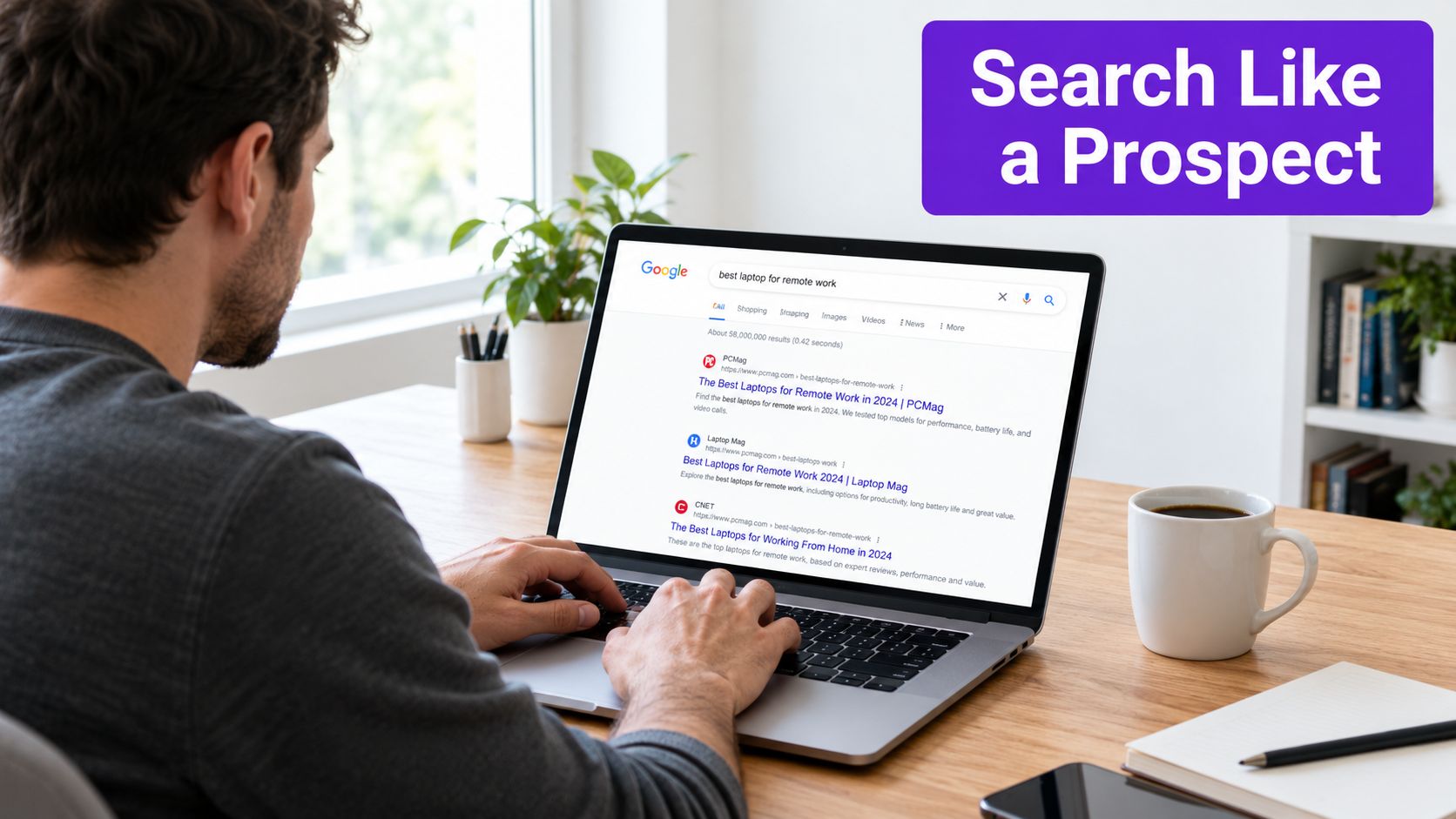
Run a compact set of searches:
Business name: Check whether your website, business profiles, and relevant mentions appear prominently.
Business name plus city: Look for location mismatches, unrelated companies with similar names, and local results that don't reflect your service area.
Business name plus service: See whether search results connect you with the work you want customers to find.
Business name plus reviews or complaints: Understand what a skeptical prospect sees when they look for customer feedback or possible problems.
For each query, save a screenshot of the first results page and note the date. Include the search terms and engine in the file name or an audit log. That record gives you a clear baseline and makes it easier to tell whether the visible story changes after you correct a listing or update your site.
Read the results as a prospect would
A restaurant owner should check whether menus, hours, and location details are consistent. A dental practice should look for accurate provider information and the right service pages. A contractor should verify that service-area results and project-related profiles point to the current business, not a former address or obsolete phone number.
Look for outdated information, negative coverage, incorrect knowledge panel details, and third-party pages that outrank your own site. Don't treat every negative result as something to erase. Your job is to understand what appears, decide whether it's accurate, and address the cause where you can. If a result is false or stale, document the page and the evidence you'll use to request a correction.
Reading Review Evidence Beyond Star Averages
A star rating is a shortcut, not an audit. BrightLocal's 2025 Local Consumer Review Survey found that only 4% of consumers never read online business reviews, while 74% check at least two review platforms before making a purchase decision. Google was used by 83% of surveyed consumers, with local news outlets at 48%, Yelp at 44%, Facebook at 40%, and YouTube at 34%. BrightLocal's 2025 Local Consumer Review Survey makes the practical point clear: your Google profile is important, but it can't stand in for a cross-platform review check.
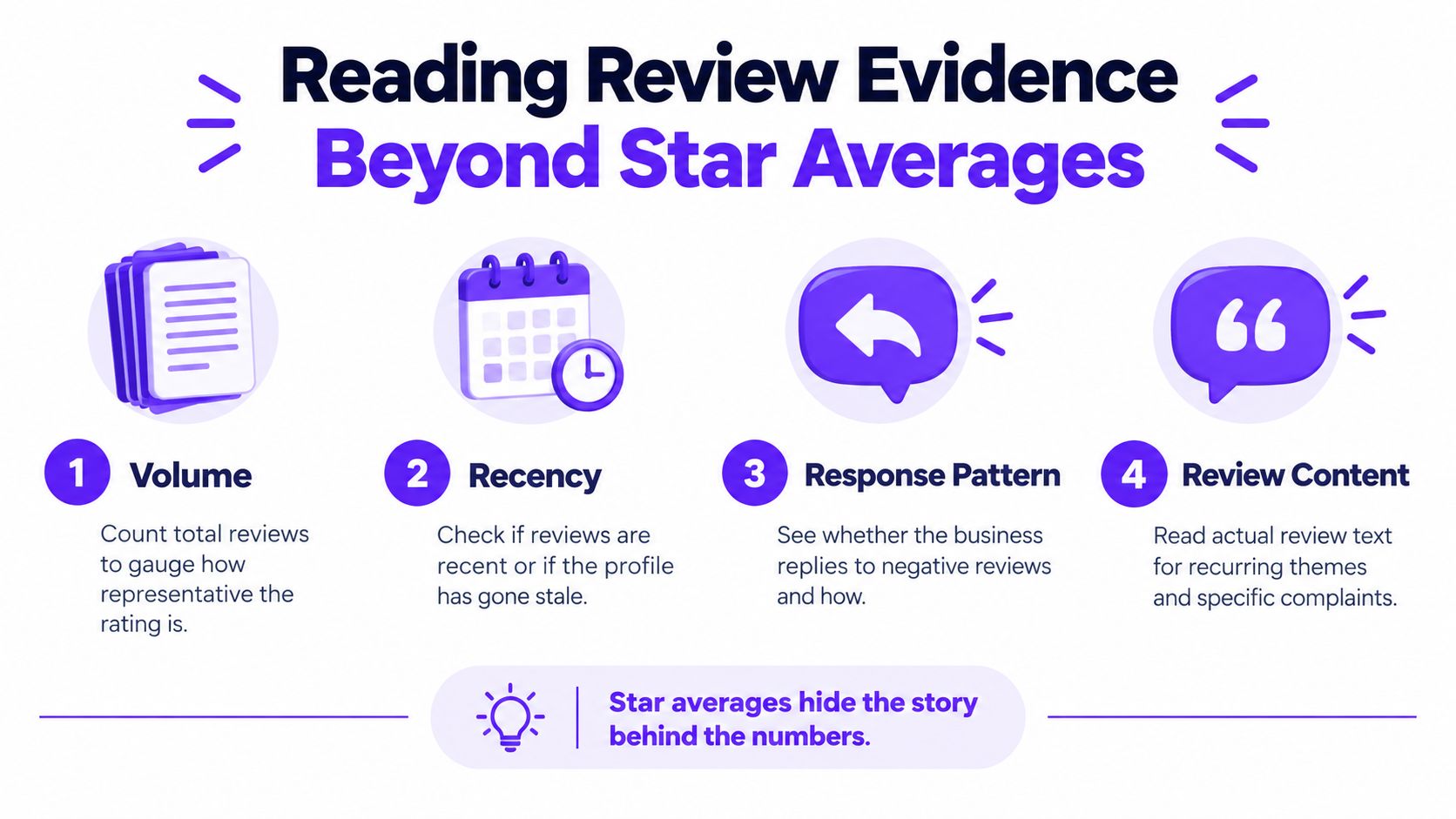
Start with the evidence behind the rating. Check how many reviews the profile has, whether they're recent, and how ratings are distributed. Read the text for recurring concerns, such as missed appointments, unclear pricing, or slow follow-up. Look at whether the business responds, especially to criticism, and whether its replies address the issue rather than becoming defensive.
Compare profiles, not just numbers
A business with a higher rating but a small review base may tell a less complete story than a competitor with more varied, detailed feedback. Don't make the choice based on an isolated example or treat review count as a quality guarantee. Instead, ask whether the profile gives a believable picture of customer experiences: Are reviews specific? Do they describe different services? Are recent comments consistent with older ones?
Trust also depends on how readers interpret reviews. BrightLocal reported that the share of consumers who considered online reviews as trustworthy as personal recommendations fell from 79% in 2020 to 42% in 2025. The survey also found that 63% lose trust after seeing mostly negative written reviews. Those figures make written detail and response quality especially important, not just the headline score.
Use the same checklist on each major platform. Note gaps between profiles, unusual bursts of similar wording, and unanswered complaints that point to a service issue. A thoughtful response can show that the business listens, but a canned reply or public argument can deepen concern. Don't chase a perfect-looking average. Build a profile that reflects real customer experiences and shows how you handle problems.
Checking Directory and Listings Consistency
The routine details are easy to dismiss until a customer arrives at the wrong address or calls a disconnected number. Treat listings consistency as part of reputation, not clerical cleanup. A prospect who finds conflicting hours or duplicate profiles has a reason to doubt the business before making contact.
Start with your most visible profiles: Google Business Profile, Apple Maps, Bing Places, Yelp, and Facebook. Add the directories relevant to your industry, such as platforms customers commonly use to find a practitioner, tradesperson, restaurant, or professional service. Claim the profiles you control, correct the facts, and note who has access so updates don't depend on an old employee or an unknown agency.
Field | Why It Matters | Common Error |
|---|---|---|
Business name | Helps customers identify the right business | Different names across platforms |
Address or service area | Shows where customers can find or hire you | Former address or unclear coverage |
Phone number | Gives customers a direct contact route | Disconnected or outdated number |
Hours | Prevents customers from relying on incorrect availability | Holiday hours left uncorrected |
Website | Sends customers to the right source of information | Old domain or broken destination |
Categories and services | Helps customers understand what you offer | Missing or overly broad service details |
Fix duplicates and unmanaged pages
When you find duplicate listings, first confirm which profile is current and whether the platform offers a process to merge or report duplicates. Don't create another listing just because you can't access the existing one. Use the platform's ownership or support process, and keep a record of the change request.
Consistent details help customers verify that profiles refer to the same business. They also give search and AI systems fewer conflicting versions to interpret. That doesn't mean every directory must be maintained equally. Prioritize the profiles customers use and the sources that accurately represent your business, then revisit the rest when a location, phone number, or service changes.
Auditing What AI Assistants Say About You
A business can have polished listings and still receive a misleading AI-generated answer. AI assistants are now part of the reputation layer: people may ask them whether a local business is trustworthy, which provider to choose, or where to find a specific service. BrightLocal's 2025 survey found that 42% of consumers trust AI recommendations for local businesses about as much as conventional reviews, while a separate survey reported that 45% used generative AI to find local businesses, up from 6% the previous year. These findings were cited in Forbes Japan's coverage of AI and local business recommendations.
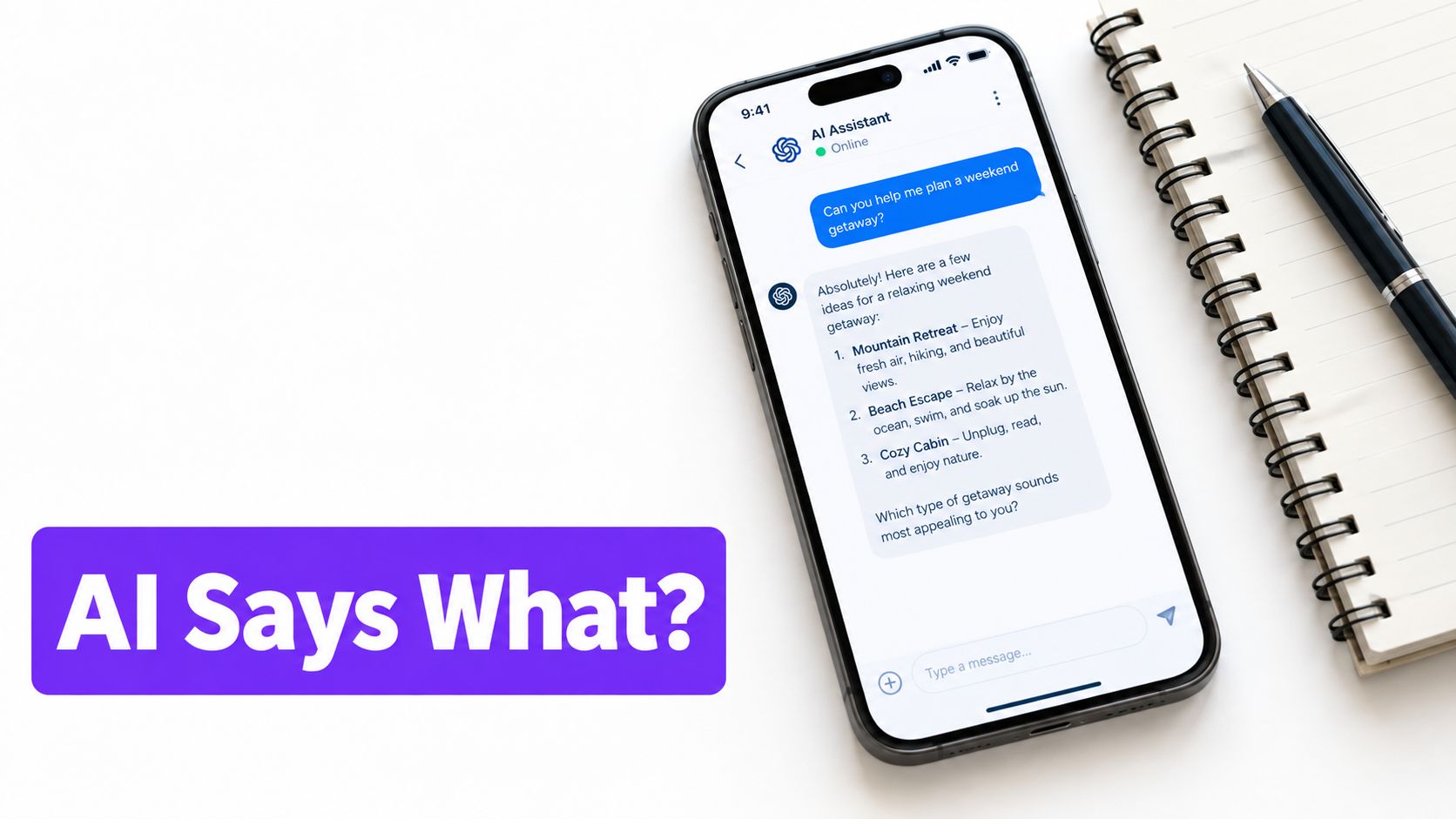
Run the same branded questions through the AI assistants your customers might use, such as ChatGPT, Google AI Overviews, and Perplexity. Keep the prompts consistent so you can compare the answers over time. Ask what the business does, whether it serves a particular location, and what customers should know before choosing it.
Save dated screenshots or copies of the responses. Check every claim against your website, verified business profiles, and credible third-party pages. Flag wrong addresses, old services, missing locations, fabricated citations, and answers that give disproportionate weight to one negative review. Record the prompt and the answer, not just your interpretation of it.
Correct the sources, then recheck the narrative
Don't assume that better conventional SEO or more reviews will automatically fix an AI answer. AI systems can combine public information from multiple places, and an outdated source may continue to shape what they say. Correct the source where possible, strengthen clear and accurate information on business-owned and authoritative profiles, and use platform feedback or correction options when they're available. Keep the evidence you used so you can see whether the answer changes.
For a more detailed process for assessing how brands appear in language models, this guide for marketers on AI visibility can help you build a repeatable prompt and documentation routine.
Use the embedded video as another prompt to check the AI surfaces your customers may consult, then compare its subject matter with your own findings:
The point isn't to force every assistant to say something favorable. It's to find factual errors, identify the sources behind them where possible, and make your public information clearer and more consistent.
Spotting Fake Reviews and Review Extortion
A negative review can be genuine, mistaken, manipulated, or part of a threat. Don't label it fake just because it's unfair or damaging. Look for patterns: a sudden wave of reviews, near-identical wording from separate accounts, reviewers with no identifiable customer history, or a demand for payment tied to threats of more negative reviews.
Google reported blocking or removing more than 292 million policy-violating reviews and taking action against more than 13 million fake business profiles in 2025, according to Vendasta's reporting on fake Google reviews. That scale is a reason to preserve evidence and report suspicious activity, not proof that any particular critical review is fraudulent.
Preserve evidence before you report
Use this triage process:
If the review describes a specific experience, check relevant customer records and respond calmly. Acknowledge the concern without disclosing private information.
If several reviews share suspicious patterns, save screenshots, profile URLs, timestamps, repeated wording, and account details before reporting them through the platform.
If someone demands money or threatens a review flood, preserve the threat messages and related records. Don't negotiate in public or promise a particular outcome. Consider appropriate professional or legal advice if the threat escalates.
A public response should stay factual and restrained: “We take this concern seriously. We can't match the details here to a customer record, but we'd like to investigate. Please contact us directly with the visit date and service details.” That gives genuine customers a route to resolve an issue without exposing their information or accusing a reviewer without evidence.
For a practical overview of warning signs and review patterns, see this resource on how to detect bogus reviews in 2026. Build a genuine review process by asking customers for honest feedback after a real transaction, without pressuring them to leave a positive rating. A burst of solicited praise can look less credible than a steady, varied record of customer experiences.
Turning the Audit Into a Repeatable Habit
A reputation check only helps if someone repeats it. Set a 30-60-90 day cadence that starts small, then expands into a deeper review. The point isn't to inspect every platform every week. It's to catch important changes, assign someone to act, and keep a record of what you find.
Monthly check-in
Keep the monthly pass short and consistent:
Review the branded search results for new or changed information.
Check incoming reviews on your primary platforms and respond where needed.
Verify core listing details if the business recently changed hours, phone numbers, staff, or services.
Test an AI prompt set and save answers that include a new factual claim or concern.
Quarterly deep audit
Use a broader review to compare the whole picture:
Recheck Google and Bing results for your brand, location, and key services.
Read review evidence across platforms, including recurring themes, response quality, and profile freshness.
Inspect directory consistency and resolve duplicates or outdated details.
Review AI answers against your verified sources and note repeated errors.
Assign an owner and next action for each issue, with a due date in your own tracking system.
When something material changes, such as opening a new location or changing your services, revisit the affected profiles and answers instead of waiting for the next scheduled audit. Keep the scorecard lean. Track branded search visibility and review activity over time, then add another measure only when it helps you make a decision. Avoid turning the process into a dashboard full of numbers nobody uses.
Reputation work is a long game. The best audit is the one your team can repeat, understand, and act on.
Dekodi helps businesses strengthen visibility and trust through creative digital services and marketing execution, including work related to reputation and listings. If you want a coordinated plan for what customers and AI systems find about your business, visit Dekodi to discuss the next steps.
Would you like this adapted for publication with any specific Dekodi style or service details?
