Published on
Written by
Dekodi Team
It's Tuesday, a little after ten. You're with a customer. Or you're on a ladder. Or you're ringing up a sale with a line behind it. Your phone buzzes in your pocket, and you can't answer. Twenty minutes later, there's a missed call and no message. You call back. Nobody picks up. That small gap, between their ring and your first reply, is where a lot of work is won or lost.
Table of Contents
The Call That Rang While You Were Busy
That caller was ready enough to dial. They had a question, a time to book, or a quote to ask for. They didn't need a long pitch. They needed a person, or at least a clear next step.
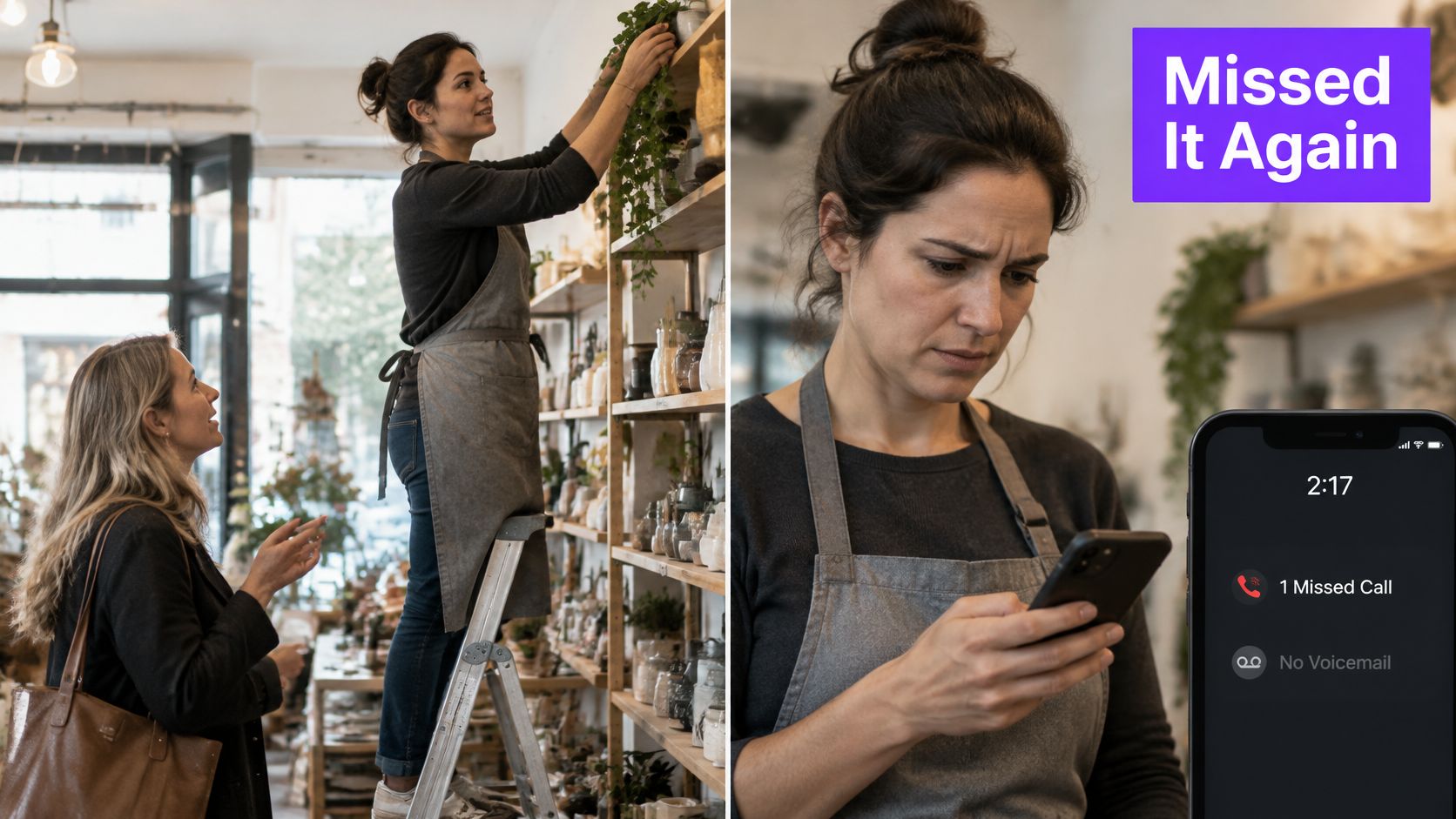
This isn't a character flaw. Owners miss calls because they're doing the work. You're serving the person in front of you. You can't also be a full-time front desk.
One Problem, One Goal
We're talking about one problem only: missed phone calls and the gap before you reply. The goal here is being chosen. That's fast follow-up. It's not about showing up on a map. It's not about collecting more reviews.
Being found matters, of course. A plumber who works on plumbing search engine optimization can get the phone to ring. But a ring isn't a job. Someone still has to answer, or answer back, while the caller still cares.
Here's the path, in one breath. First, what callers do when nobody answers. Next, how fast your first try has to be. Then a follow-up you can run this week with the phone you already have. Last, how to make that return call look like you instead of a stranger.
A missed call isn't lost yet. It's lost in the quiet minutes after it.
You'll leave with a simple routine. Not a new stack of apps. Not another login to forget.
A short text that names your business. One recognizable callback. A simple note of what happened. That's the whole idea, and for most small shops, practices, and crews, it's enough to start winning back calls you'd otherwise never hear about again.
Check the Phone Before You Chase Anyone
Start with a question many owners skip. Is the phone itself letting calls through? Some misses have nothing to do with effort. A phone can show full bars and still fail to ring after it moves between weak coverage areas. The caller hears silence, or the call drops, and you see nothing at all.
Run this quick check this week. It takes ten minutes and costs nothing.
Six Checks, in Order
Call your own line: Use a second phone to call your business number. Then call that line from your own cell. Listen to what callers hear, ring by ring.
Check silent settings: Turn off any do-not-disturb or focus mode that silences unknown numbers during work hours. Plenty of new customers are unknown numbers.
Set up voicemail: Confirm voicemail works and the greeting names the business. A missing greeting is a dead end. Say your name, your hours, and when you'll call back.
Check call forwarding: Call forwarding sends calls to another number. If calls go to an old phone or a line nobody watches, fix that first.
Note the weak spots: Write down where you usually miss calls. The truck, the back room, the job site. If one spot is weak, Wi-Fi calling or a second line may close the gap.
Name an owner: If two people share the line, agree who owns missed phone calls before lunch and who owns them after. Nobody should assume someone else is watching.
An office line that rings in an empty room is a coverage problem, not a motivation problem. The same goes for a number printed on ads that nobody checks. If you're paying for calls through something like PPC for roofers, that number needs a real person behind it.
Practical rule: Fix the path before you blame the follow-up.
Once calls can reach you, and someone owns the ones that don't get answered, the rest of this gets much easier.
What Happens to a Missed Call
What does a missed call turn into? Most owners picture a voicemail waiting patiently. That's often wrong. In a 2025 survey of 1,000 U.S. consumers, only 42% said they leave a voicemail after a business fails to answer, while 24% switch to online chat and 21% immediately call another business, according to Beside's missed call cost report. In that same survey, 78% said they had ultimately taken their business elsewhere after an unanswered call.
So voicemail isn't the default. It's one path out of several, and not the biggest one. Most callers do something else, and a lot of them don't wait around for you to find out.
What a Missed Call Turns Into
What the caller does | What it gives you | What you can do this week |
|---|---|---|
Leaves a voicemail | A message you can return | Call back with your name, the business, and the reason in the first sentence |
Opens online chat or sends a text | A way to reach you if your number is easy to find | Answer with a short text that names the business |
Calls the next business | The conversation goes elsewhere | Your first reply speed is the only lever you control |
Hits a line with no voicemail | No path forward at all | Set a voicemail greeting on every line that rings |
Read each row as a fork. A voicemail is a thin thread, but it's a thread. You have a name or a number and a reason to call. Chat or text is still a path, as long as your number and website make it easy to find. Calling the next business is the hard one. That caller has moved on, and you only control your speed.
The worst case is the last row. No answer and no voicemail means no path forward at all. A 2016 observational study of 85 small businesses across 58 industries found that only 37.8% of inbound calls reached a live person, another 37.8% went to voicemail, and 24.3% received no answer and no voicemail option, as reported in CallForce's cost of missed calls analysis. Taken together, 62.1% of calls did not reach a person.
Treat those figures as an example of the problem, not a universal rate for every shop. The useful part is the split. A caller who can leave a message has a chance. A caller who hits a dead end has none.
What This Means for a Local Business
For a restaurant, shop, practice, contractor, or local service, a caller often wants one simple thing. Book a time. Ask a price. Check whether you're open. Confirm you're the right fit.
Being on Google isn't the same as being reachable. A person can find you in ten seconds and still never talk to you. That's the quiet leak in a lot of marketing. The search worked. The phone didn't.
So do two plain things. Set a voicemail greeting on every line that rings. And if the call came after hours, say when you'll call back. Morning is fine. A time beats a guess.
Don't treat the table as a score to hit. Use it to see which path your number gives a caller right now. Then fix the worst row first.
How Fast the First Reply Has to Be
A caller who just hung up is still holding the phone. Give it an hour and that same person is back at work, eating lunch, or already booked with someone else. The clock starts the moment they give up on you.
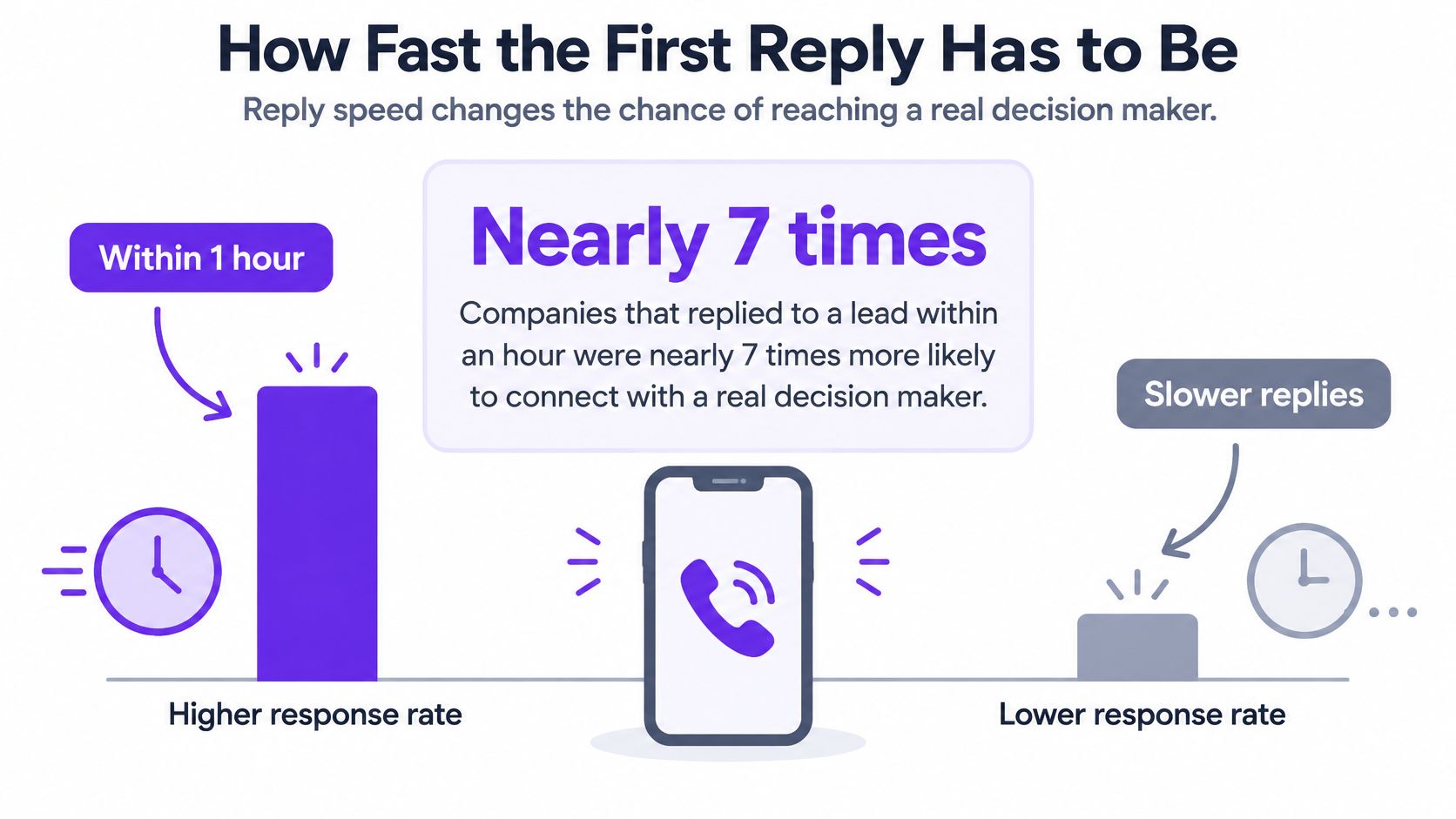
Here's the figure worth keeping. Companies that contacted a lead within an hour were nearly seven times as likely to qualify it as companies that waited one additional hour (Harvard Business Review, 2011). Qualifying means confirming a real opportunity: the right person, a real need, worth your time. That window works because the lead still remembers you, and memory is what turns a call into a conversation.
The same pattern shows up when researchers test real businesses. In a test of 2,241 U.S. companies, the average response time was 42 hours among companies that responded within 30 days, only 37% responded within an hour, and 23% never responded at all, according to Vida's speed to lead report. Read that as good news. Most businesses you compete with are slow, so a fast reply stands out before you've said a word.
Why the First Minutes Matter
The mechanic is plain. In the first minutes, the person still remembers why they called. They're still near the phone. They may not yet have reached the next business.
Wait a few hours and the picture changes. They've booked someone else, solved it another way, or moved on with their day. Your callback lands as an interruption instead of an answer. On your side, the call becomes an errand on a list. On theirs, it's already cold.
The caller hasn't forgotten you on purpose. Life just filled the gap you left.
Set a working target you can keep on your worst day, not your best. A first try inside the hour, every time. Within five minutes when you can. Skip the fantasy of answering mid-rush. Pick a real target and a set time to check.
Make that first touch a short text with your name on it. "Hi, this is Sam at the front desk, sorry we missed your call." One line that says who you are, one clear thing they can do next: reply to the text, tap to call, or pick a time. Then make one callback from the same number, so it rings under the name they just read. A named text plus one recognizable call is the whole play, and a long message just asks a stranger for work.
Measure two things while you're at it. How long until your first try, and whether the talk reached a real next step. A booked visit counts. A clear no counts too. Both beat a call that just sits there.
The Follow-Up You Can Run This Week
You don't need to buy anything to start this. You need one number, two check-in times, and a short script you don't have to think about. The target is a first try within five minutes when you can, and inside the hour when you can't.
That five-minute window matters for a reason. An InsideSales study reported that conversion rates were eight times higher when the first attempt occurred within five minutes than when it occurred later, from five minutes to 24 hours, as summarized in Plura's lead response time statistics. Read that as contact and qualification performance, not a guaranteed sale. The person is still available and still remembers the request. That's what you're using.
Here's the routine at a glance before we walk through it.

The Six Steps
Pick one number: Use one business number everywhere. Turn on branded caller ID if your carrier allows it. That shows your business name on their screen instead of a bare number.
Check at set times: Look at missed phone calls at two set times each day, or turn on a notification you'll see. A badge you ignore doesn't count.
Text strangers first: For a number you don't know, send one short text. Your business name, that you missed their call, and one way to reply or book. Keep it to two short lines.
Call once from the same number: Use the number in your text. If nobody picks up, leave a voicemail with your name, the business, and the reason in the first sentence.
Write it down: Note the time of the miss, the time of your first try, and whether you reached a person or set a next step. A paper log by the register works fine.
Stop after one text and one call: If they don't reply, stop. More than that feels like spam, and it teaches people to block you.
For someone already on your customer list, call first. They know you, so the number won't look strange. For a stranger, text first so the callback is expected. Same goal, different order.
This bit of video walks through the same idea in plain terms, if you'd rather watch than read.
Measure three things only. How fast you tried. Whether you connected. Whether they booked or opted out. Opted out means they asked you to stop texting, and you honor it right away. That's enough for this week.
Keep the same discipline you'd want from any ad spend. If you're running something like Facebook ads for landscaping, the ad did its job when the phone rang. This routine is how you finish the job.
One more honest note. Some days you'll miss the five-minute mark. Fine. Inside the hour still beats tomorrow by a wide margin. A routine you keep beats a perfect one you drop by Friday.
A Return Call People Will Actually Answer
Here's the conflict. You need people to pick up. And plenty of people are right to ignore a number they don't know. Scam calls are common enough that caution is reasonable. Don't blame the caller for hesitating.
The numbers back that up. A 2025 survey found that 48% of consumers never answer calls from numbers they do not recognize, and another 32% answer only sometimes, according to Praktivo's missed call text back statistics. So your return call starts with a handicap before it even rings.
The goal isn't to make people answer every call. It's to make your business easy to check, without teaching anyone to ignore safety warnings.

Five Plain Moves
Use one local number: Don't show a new caller ID every week. A steady local number is easier to recognize and easier to save.
Turn on branded caller ID: If your carrier offers it, use it. Your business name on the screen does half the trust work before anyone speaks.
Match the name everywhere: The name on the call should match your website, your Google listing, and your text. If a person searches the number, they should land on you.
Lead voicemail with who and why: Say your name, the business, and the reason in the first sentence. Don't make them listen to thirty seconds to learn who's calling.
Identify every text: Put your business name in the first line and give a clear way to say stop. A text with no name looks like bait.
A callback people can verify beats a callback they have to guess at.
One thing not to do. Don't buy a list and dial strangers to make up for missed phone calls. That trains the wrong habit, and it can break the rules on unwanted calls. Your missed callers already raised a hand. Work with them.
Flip it around and look at your own phone. An unknown number with no name and no message gets ignored. You do it yourself. A short text with your business name changes the math, because by the time your callback rings, the person already knows who's on the line.
That order matters. The named text does the checking work for them, and the recognizable call cashes it in. Most missed calls are lost before anyone ever returns a voicemail, so this pair is the whole play.
Trust meets being chosen here. The fastest reply in town still fails if it looks like a scam. Make the call easy to recognize, easy to verify, and safe to return. Do that, and you don't have to call more often. You just get answered more often.
Book a Walkthrough and Leave With a Map
When calls get missed, the usual fix is to buy something. A new texting app. A separate answering service. Another login on top of the website and the listing. Each one sounds small. Together, they cost more than the subscriptions.
We call that the Patchwork Tax. Too many choices. Tools you pay for but barely use. Time lost switching between apps. No clear view of what's working. And leads that go cold while you sort it out.
The pile is real. Local service teams now juggle a growing stack of marketing tools, and every app switch pulls attention away from the phone. The missed caller does not wait while you check a second dashboard. You need less, connected better.
Clear Beats More
More options get attention. Clear options get decisions.
So keep this simple. The follow-up in this article should live next to the number on your site and your listing. One owner for missed calls. One short text with your business name on it. One recognizable callback. One simple record of speed and bookings. Five pieces, one working plan.
We treat fast follow-up as part of being chosen, inside one plan, one partner, and one scoreboard. That is how every engagement with us runs. We start with where you are today and what you're trying to achieve. We scope what it will take and what it will cost, across services, software, and spend, before anything goes to market. Then we execute, monitor, and adjust against the outcome you defined. You see where every dollar goes, and no new vendor appears halfway through.
If you'd like a hand mapping it out, bring your current number setup, your voicemail greeting, and a rough sense of when calls get missed. That's enough to start. We'll help you turn the routine above into something your whole team can run on a busy Tuesday, when the jobs and the phones collide.
We help owners fix follow-up as part of one clear plan to be found, be trusted, and be chosen, so missed phone calls get a fast, recognizable reply instead of another app in the pile. Visit Dekodi to see how we work, and contact the team when you're ready to map your next step.