Published on
Written by
Dekodi Team
You are in the truck between jobs. Your phone buzzes with another lead notification. By lunch you have a screen full of names, and by Friday most have gone quiet. That gap between a name and a booked estimate is where Facebook Ads for landscaping either makes money or wastes it. This guide shows you how to close that gap, with honest costs, a simple setup, and a scoreboard that tracks jobs, not clicks.
Table of Contents
The Lead That Never Became a Job
It usually starts the same way. You pay for an ad. A homeowner taps the form. You see the notification while you are on a mower, in a supply yard, or finishing a cleanup. You call back when you can, maybe an hour later, maybe that evening.
The homeowner has already talked to two other companies. One answered right away. One sent a text with a time to visit. Your call goes to voicemail, and the lead you paid for becomes a name you will never meet.
The frustration is not the ad itself
That outcome does not mean you are bad at marketing. You are busy doing the work you sell. Most owners we talk to got here by referrals and repeat customers, not by sitting at a desk watching notifications. The system around the ad was never built, so good inquiries leak out.
Facebook and Instagram are still worth testing for local work. Meta reports that more than 10 million businesses have used Meta advertising, with the majority small or medium-sized businesses, and the same material claims 80% greater discovery on Facebook than on brand or retailer websites. Treat that as a platform-reported figure, not a promise. The useful point is simple. Paid social can put your work in front of homeowners before they search on Google.
Practical rule: Do not judge an ad by how many names it produced. Judge it by how many estimates it booked.
Speed matters more than most owners expect. Companies that replied to a lead within an hour were nearly 7 times as likely to reach a decision maker as those that waited longer (Harvard Business Review, 2011). For landscaping, that is the difference between a real conversation and a polite no thanks.
Landscaping demand often starts with a trigger. A storm drops limbs. A neighbor gets a new patio. A listing photo shows a tired yard. Facebook can catch that moment, but only if someone replies fast and the next step is clear. The ad is not the finish line. It is the start of a system that has to carry a person from interest to an estimate to a signed job.
What Facebook Ads Really Cost Landscapers
Start with honest planning numbers, not hopes. The closest published category to landscaping is U.S. Home and Home Improvement. Available 2026 benchmark data reports an average Meta cost per lead of $42.95, a cost per click of $2.18, and a click-to-lead conversion rate of 5.32% for that category. At that rate, about 19 clicks produce one lead on average.
That matters for your wallet. One hundred leads at $42.95 each implies about $4,295 in lead cost before sales labor, missed calls, duplicate inquiries, or any help you hire. If half those leads never book a visit, your real cost per booked estimate is much higher than the number on the dashboard.
The right yardstick for a local service business
All-industry averages make landscaping look broken when it is not. The same benchmark puts all industries at $27.39 per lead, $1.80 per click, and an 8.54% conversion rate. A homeowner asking about a retaining wall or recurring lawn care is not buying a shirt. The decision is bigger, the service area is smaller, and trust carries more weight.
Metric | Home & Home Improvement | All Industries |
|---|---|---|
Average cost per lead | $42.95 | $27.39 |
Average cost per click | $2.18 | $1.80 |
Click-to-lead conversion rate | 5.32% | 8.54% |
Use these figures to plan, then replace them with your own. Your service mix changes everything. Recurring maintenance can support a different acquisition cost than a one-time cleanup or a design and build project. One blended budget for all services hides which offer pays.
Plan by service: Set a target cost per qualified lead for maintenance, seasonal work, and higher-value projects separately.
Plan by outcome: Track cost per booked estimate next to cost per lead from day one.
Plan by area: A tight, profitable service area beats a wide radius that burns crew time on drive time.
A cheap click is not a bargain if it never becomes a quote. Plan around qualified leads and booked jobs in our Start, Fund, Market approach. Start defines the outcome. Fund sets what you can spend to get it. Market runs the ads and reports back against that plan.
Setting Up a Campaign That Finds the Right Homeowner
A good setup saves a crew before it spends a dollar. A lead can look clean in Ads Manager, then the address lands 45 minutes outside the route and the homeowner wanted a one-off mow for a rental yard. That is a targeting failure wearing a nice costume.
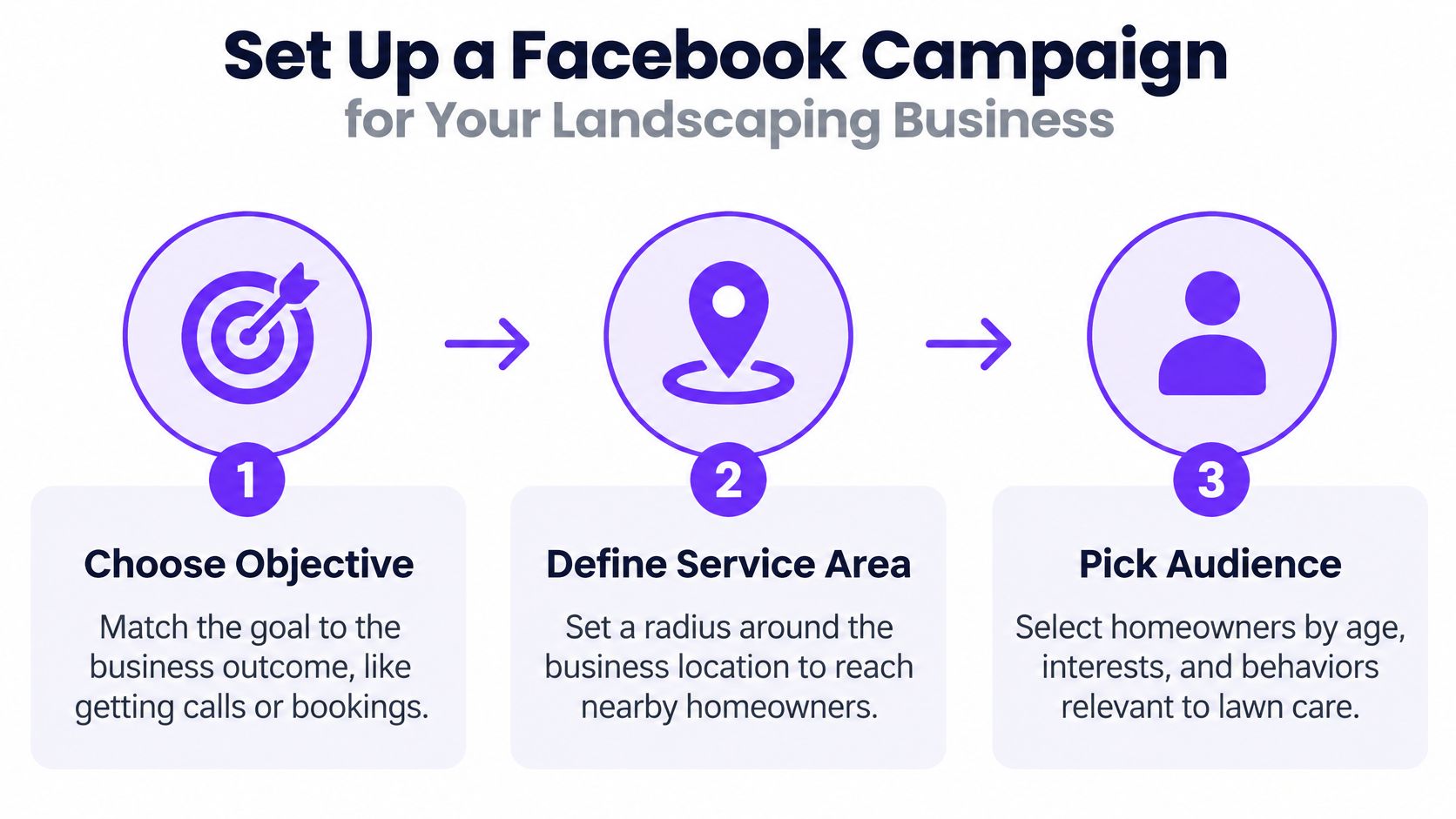
Meta explains that the campaign objective determines what the system tries to optimize, so a conversions objective looks for people likely to complete the desired action. Choose traffic and Facebook finds clickers. Choose leads or conversions and it hunts for people more likely to request work. For maintenance, irrigation, cleanup, or hardscape projects, pick the outcome closest to a real inquiry, then judge it by booked estimates.
Build the fence first
Draw the service area around routes your crews can run profitably. Cut neighborhoods that add drive time, exclude current customers when the offer is for new work, and keep the radius honest even if it makes the audience look small. A small audience of likely buyers beats a big one filled with DIY browsers.
Give the homeowner a reason to act this week. “Spring bed refresh,” “irrigation startup check,” or “defined cleanup with a firm estimate window” says more than “contact us.” Nearby trades handle the same problem with project framing; you can find Facebook ads for construction firms to see how they scope offers without turning every ad into a vague quote request.
Change one thing at a time when you test. Hold audience and offer steady, then rotate three creative angles: before-and-after photos shot from the same angle, a seasonal problem named plainly, and trust proof such as reviews, licensing, warranty terms, or crew photos on real jobs.
Attention is easy. Decisions need friction in the right place.
Send the click to one fast mobile page for that one service. Your Facebook presence should look alive before the ad runs; our notes on building a Facebook page that supports advertising cover the basics. Install the Meta Pixel before launch so Meta can learn who submits a real request and you can trace each booked estimate back to the ad that earned it.
Why Cheap Leads Can Be the Most Expensive Mistake
Your office manager spends a Tuesday calling twenty fresh lead-form fills. Eleven go to voicemail. Five sit outside your service area. Two wanted free ideas for a mulch job they plan to do themselves. One booked an estimate and cancelled before the truck rolled. The dashboard called those leads cheap. The payroll hours chasing them disagreed.
Facebook lead forms produce that pattern for a simple reason. A homeowner can submit in a few taps without leaving the app, so the form collects curiosity as easily as it collects buyers. A 2026 audit of 145 U.S. lawn and landscaping advertisers found lead-form cost per lead typically ran 30% to 50% lower than landing-page cost per lead, while lead-form leads closed at roughly half the rate. Only about 15% of advertisers in that audit used lead forms. The cheap number hides the expensive one.
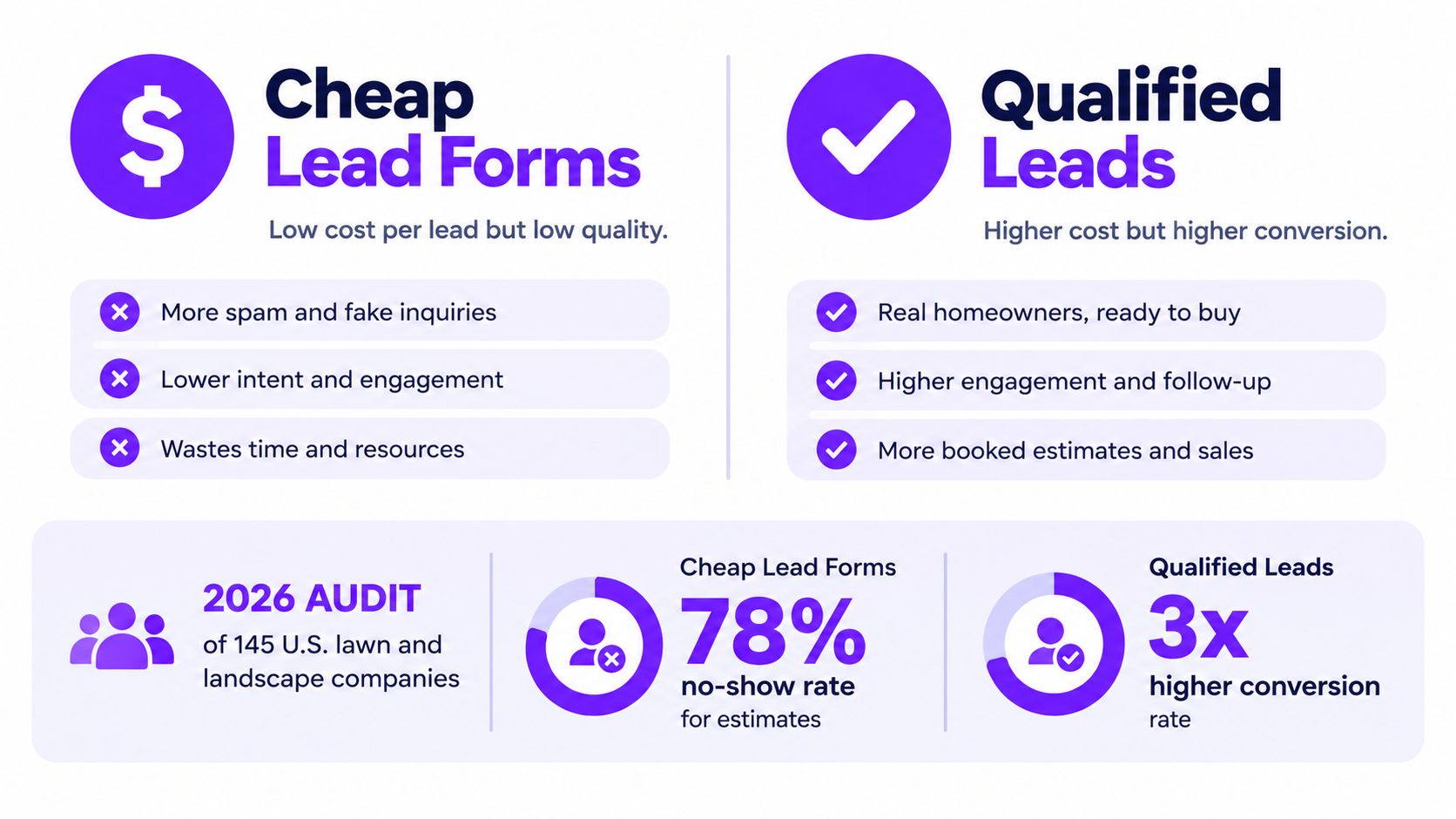
A landing page flips the math. The homeowner reads what you do, looks at real job photos, and decides you are worth a call. That extra minute filters out the accidental taps and the people who never meant to hire anyone. Run a quick check of your web reputation before you point ad traffic at any page, since weak reviews or a stale listing can bounce the good visitors you paid to reach.
Qualification handles the rest, one plain question at a time. Confirm the address sits inside your radius. Ask the project type so the right person calls back. Ask whether they own the home, when they want the work, and what budget range they have in mind. Every answer saves a wasted estimate visit.
Should you kill lead forms entirely? Test them first. If they produce booked estimates at a fair cost in your market, keep them running. Just never let cost per lead make that call for you. Your crews get paid from closed jobs, so grade every source on the revenue it deposits.
Measuring What Matters from Ad to Booked Job
A click costs you money. A booked job pays you back. Everything between those two points is where landscaping ad budgets die, and it is exactly where your measurement should live.
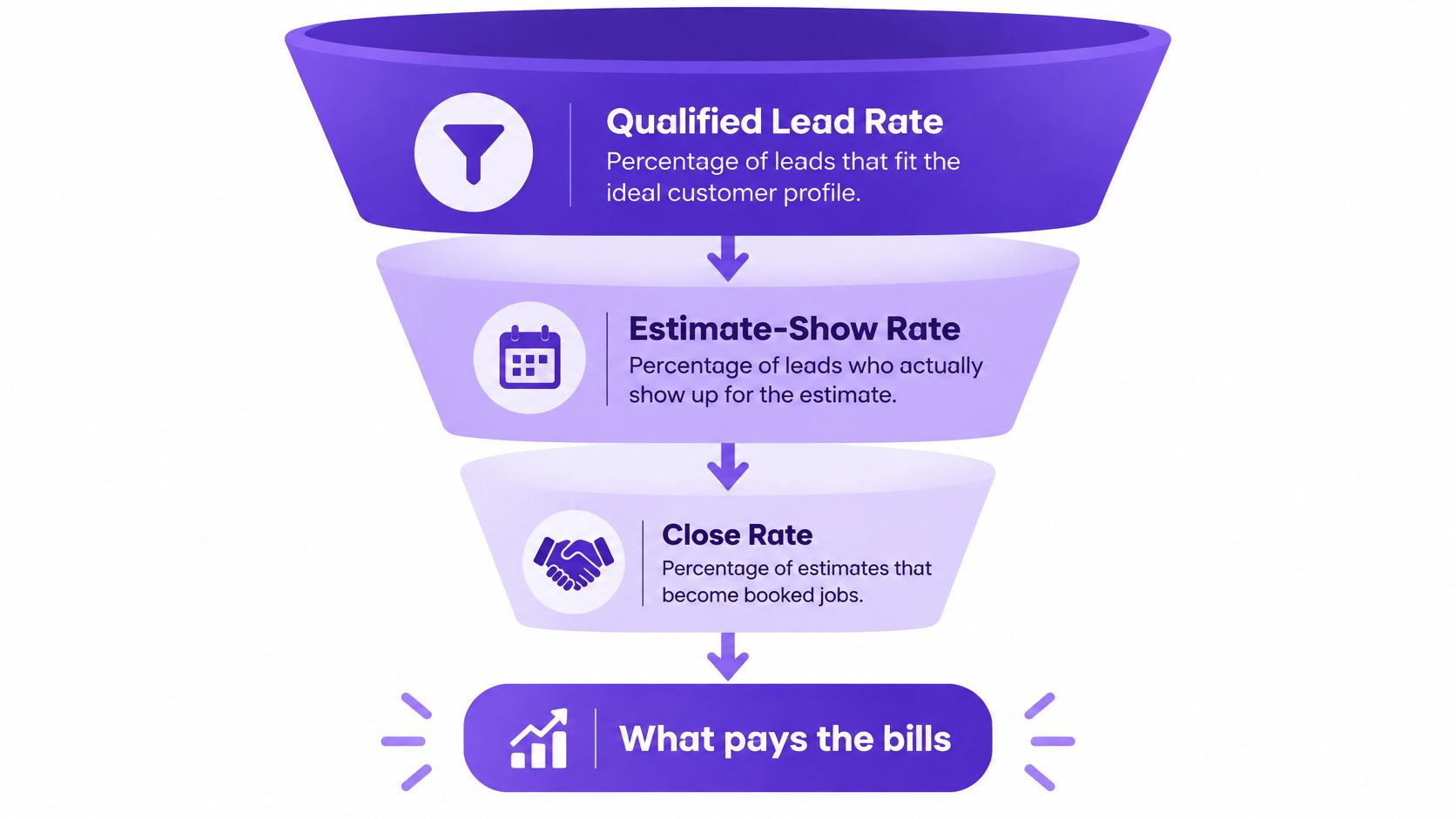
Four rates carry the chain from first inquiry to signed work:
Rate | What it tells you |
|---|---|
Qualified lead rate | Share of inquiries that fit your area, service, and job minimum |
Booked estimate rate | Share of qualified leads who agreed to a visit |
Estimate-show rate | Share of booked visits where the homeowner actually showed up |
Close rate | Share of estimates that became signed jobs |
Revenue per advertising dollar ties the chain to money. This funnel shows how the stages connect.
Connect the ad to the offline sale
Most landscaping jobs close offline, after a call or a site visit. Meta's Conversions API is a tool that connects website, messaging, and offline sales activity to Meta so server events can support measurement and optimization like Pixel events. In plain words, it can tell Meta that a lead became a booked job, so the system learns which ads produce revenue instead of form fills.
Meta notes that only matched events can support attribution and delivery optimization. That is why a clean customer list matters. Consistent names, phone numbers, and lead records let the system match the sale to the ad. A messy list breaks the chain, and you are back to guessing.
Speed belongs on the same scoreboard. A widely cited study analyzed more than 15,000 leads and 100,000 call attempts and found the odds of qualifying a lead were up to 21 times higher when contact happened within five minutes rather than 30 minutes. The same research reported the odds of reaching the person fell roughly 100 times over that interval. Run lead ads only when someone can answer.
So build speed into the workflow. An automatic text and email go out the moment a form arrives, with a clear next step. New leads sit at the top of the call list, never under the paperwork pile. Every lead gets marked the same way: contact made, estimate booked, estimate shown, job won or lost.
Keep a weekly whiteboard with leads, qualified leads, estimates booked, estimates shown, jobs won, and revenue, then review creative against those numbers. Planning ranges from industry sources include roughly 0.8% to 1.4% click-through rate, $10 to $20 cost per thousand impressions, and 5% to 12% form conversion for local-service campaigns, though your geography and season will move results. Rotate creative before frequency causes fatigue, and cut any ad that wins clicks but loses estimates.
The Patchwork Tax and Why One Plan Beats a Pile of Tools
Many owners buy marketing one piece at a time. A freelancer for ads. A cousin for the website. A new app for reviews. Another app for texting. None of it talks to each other, and nobody owns the whole picture.
We call that hidden cost the Patchwork Tax. You pay it in tools you barely use, time lost switching between apps, confusion about what is working, and leads that go cold while you hunt for information. The ad budget is visible. The tax is not.

What the pile really costs you
There are 15,384 marketing tools on the market (chiefmartec, 2025). Marketing teams use only 33% of what their marketing tools can do, down from 58% in 2020 (Gartner, 2023). Workers switched between apps about 1,200 times a day and lost nearly 4 hours a week refocusing (Harvard Business Review, 2022). A busy landscaping owner has even less slack than that.
Fewer, connected tools beat a bigger pile. Your ads, website page, customer list, and follow-up texts should act like one system. The same logic applies on the estimating side. If your team is pricing work from scattered notes, purpose-built help like Exayard landscaping estimating software is worth reviewing as part of one connected process, from first ad click to a clear, professional estimate.
You do not need more marketing pieces. You need the pieces you have to work together.
One plan also changes how customers find you. People now ask AI search tools like ChatGPT and check maps and reviews before they call. If your ads say one thing, your website says another, and your reviews are thin, trust drops. Being found gets the click. Being trusted gets the call. Fast follow-up gets you chosen. That chain breaks when every piece is bought separately.
Your First Step This Week
Do one practical step this week, on your own, before you spend a dollar on ads. It takes about an hour and it will make every future campaign cleaner.
Pick one service offer you want more of. Write down the exact area you will serve for that offer and the minimum job size that makes it worth a visit. Then write three headlines for the three creative angles, transformation, seasonal urgency, and trust proof, using photos from real jobs you already have on your phone.
Choose the offer: Name the service and the outcome, such as a spring cleanup with bed refresh, not general landscaping.
Set the boundary: List the towns or radius you will accept and the work you will politely decline.
Draft the follow-up: Write the text you will send within minutes of a new inquiry, with a specific time window for the estimate.
That small exercise forces the decisions most ads skip. You will know who the ad is for, what it promises, and what happens in the first five minutes after someone raises a hand. If you want low-cost ways to support that plan while you test paid ads, our roundup of free places to advertise your business gives you options you can set up without a budget.
We handle this problem by replacing the pile of one-off vendors with one plan, one partner, and one scoreboard, so your ads, website, reviews, and follow-up work as one system built to help you be found, be trusted, and be chosen. If you want a clear map for your business, book a free 30-minute walkthrough with us. No pitch and no pressure. You leave with a clear map either way, including what to fix first and what can wait.
Bring your three headlines to that conversation if you wrote them. Bring your service area and your minimum job size too. We will help you turn that rough draft into a funded test with honest targets for qualified leads and booked estimates. That is how Facebook Ads for landscaping stops being a gamble and starts being a system you can manage.
We help landscaping owners turn Facebook ads into booked estimates with one connected plan for ads, trust, and fast follow-up, measured on one scoreboard. Visit Dekodi to see how our Start, Fund, Market approach works, and book a free walkthrough if you want a clear map for your next campaign.