
Plumbing Search Engine Optimization for Local Calls
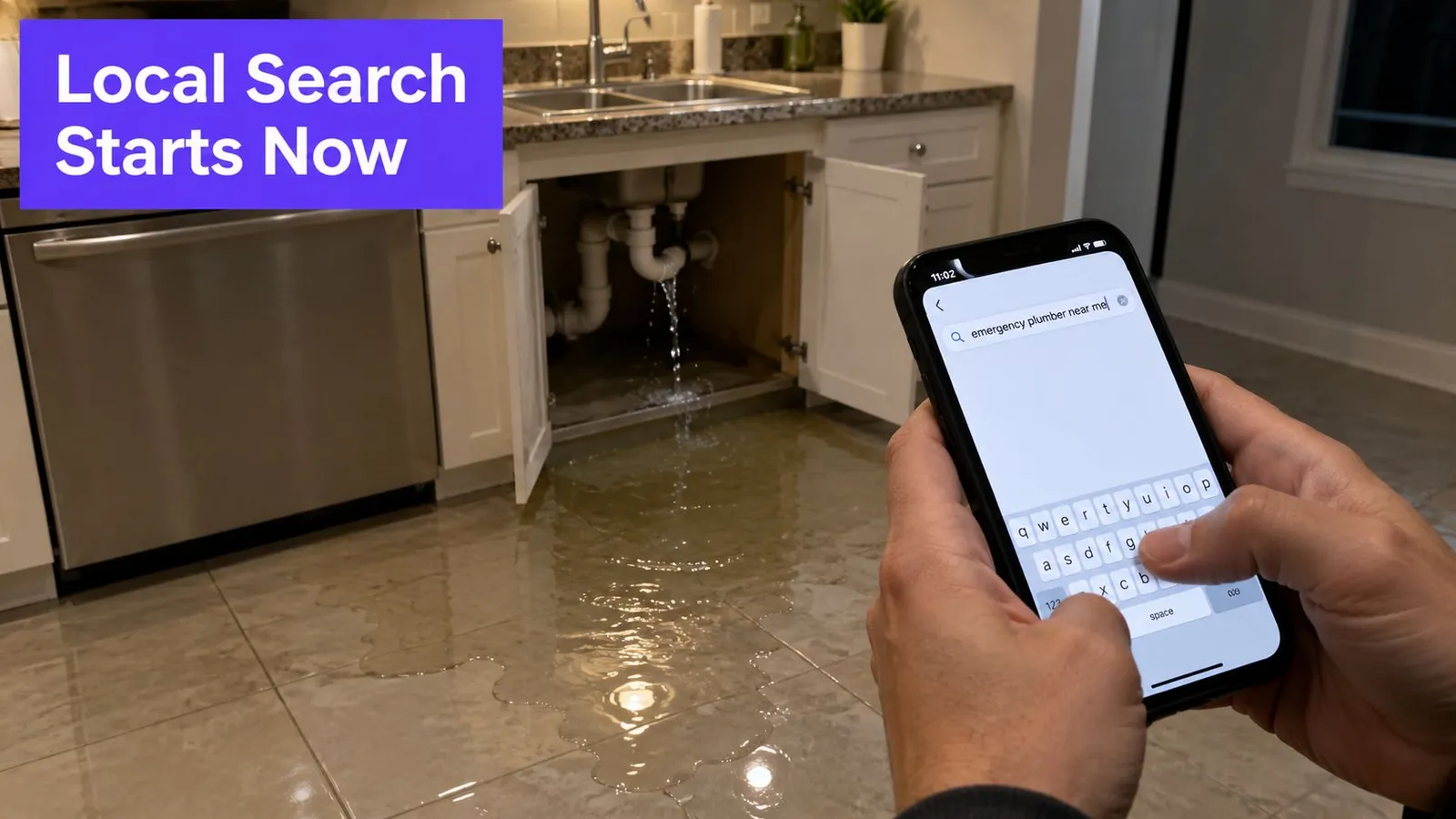
At 11 p.m., a homeowner watches water spread across the kitchen floor. Their phone is in one hand. Their thumb is typing “emergency plumber near me.” They…
At 11 p.m., a homeowner watches water spread across the kitchen floor. Their phone is in one hand. Their thumb is typing “emergency plumber near me.” They need someone nearby who can answer, not a page full of general plumbing advice.
You may already have a website, a Google listing, and a few marketing tools. The frustrating part is knowing whether any of it is bringing in the right calls. Plumbing search engine optimization is the work of making your business easy for Google, Maps, and AI tools to match with a nearby plumbing job. The goal isn’t a prettier ranking report. It’s more qualified calls that turn into booked work.
Why Plumbing Searches Start Nearby
A plumbing search is a job description typed into a phone. The person behind it wants someone close enough to show up, and the plumber whose listing shows accurate services, hours, coverage, and a clear way to call has the edge in that moment.
Plumbing demand falls into three types: urgent emergencies, planned repairs, and planned installs or replacements. Each is a different job. An emergency caller needs to know whether you answer now and how far you will travel. Someone comparing water heaters wants options, rough costs, and an easy way to request an estimate.
Treat them as separate searches, because Google does.
The searches that matter to a plumber carry real intent. Someone typing “water heater repair near me” is past the browsing stage, and a “drain cleaning” search with a town name attached usually means a booking decision within hours. You don’t run a storefront, but the same local intent applies: the search happens close to where the work is needed.
Your Google Business Profile is the free listing that shows your business name, hours, and services on Google and Maps. If it is unclear or out of date, a ready-to-call customer picks the next plumber on the list. Local visibility decides who gets the call, and the work starts with being accurate and easy to reach.
The Local SEO Levers That Matter Most
Six connected levers cover the essentials. Use the table to see what each one does, what to check, and which business goal it supports.
| Lever | What It Does | Check This Month | Goal |
|---|---|---|---|
| Google Business Profile | Shows your name, hours, services, and area on Google and Maps | Confirm services, service area, hours, and photos are complete | Being found |
| Service pages | Match your website to specific plumbing jobs people search for | Make sure each core job has a clear page and phone number near the top | Being found and chosen |
| Reviews | Build trust before the first call | Reply to every new review | Being trusted |
| Consistent listings | Confirm the same name, address, and phone everywhere | Compare your website, profile, and directories | Being trusted |
| Call and lead speed | Turn a search into a booked job | Check who answers and how quickly new leads get a reply | Being chosen |
| AI search presence | Help tools like ChatGPT identify your business in answers | Keep business facts, service pages, and job-based reviews clear | Being found |
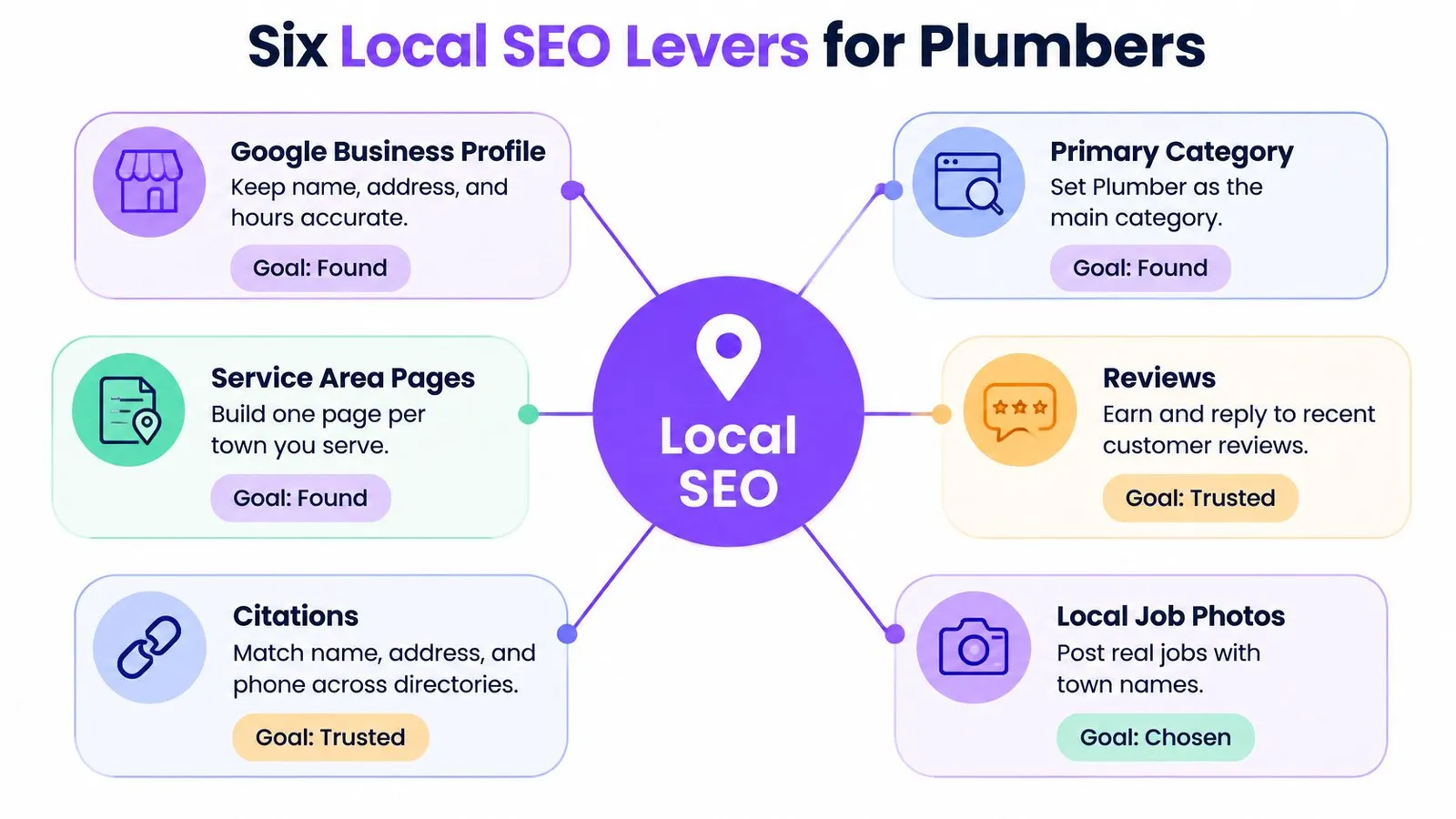
The first two levers help search engines match your business to a job. Your profile describes who you are and what you do. Your service pages explain the specific work you handle. Reviews and consistent listings help people trust what they see. Then call handling and clear follow-up help turn that interest into a booked job.
A common problem is trying to manage all six through a growing pile of subscriptions and disconnected vendors. We call the hidden cost the Patchwork Tax: tools that barely get used, time lost switching between apps, too many choices, and leads that go cold while nobody knows what’s working. Constant Contact reported in 2024 that 73% of small businesses lacked confidence in their marketing strategy, and 56% had an hour or less a day for marketing (Constant Contact’s small business marketing survey). Gartner reported in 2023 that marketing teams used only 33% of what their marketing tools could do, down from 58% in 2020 (Gartner’s marketing technology research).
More options get attention. Clear options get decisions.
Six connected levers in one plan are easier to manage than six separate projects. Dekodi Group’s approach is Start. Fund. Market. We set the outcome, define the investment, and connect the work to one scoreboard.
How to Set Up Your Google Business Profile This Week
Google says local results are shaped mainly by relevance, distance, and prominence. Relevance is how closely your profile matches a search. Distance is how far you are from the searcher or the place named in the query. Prominence reflects how well-known your business is, including signals such as links and customer reviews. Google also says businesses can’t request or pay for a better local ranking (Google’s explanation of local ranking factors).
That makes accuracy more useful than keyword tricks. Set aside time this week to check your profile against the jobs you want to book.
- Match your business details. Use the same business name, address, and phone number on your profile, website, and invoices. Keep your real business name as it is, because adding service keywords can violate Google’s guidelines and put your listing at risk.
- Choose an accurate primary category. Set the main category to plumber, then add secondary categories only for work you really provide, such as drain, water heater, or sewer services. The category helps Google understand what searches fit your business.
- List your services plainly. Add specific services such as drain cleaning, water heater repair, and slab leak repair. Clear service details make it easier for customers to see whether you handle their problem.
- Set a truthful service area. Include the towns you really reach, not every nearby community you hope to attract. A service area that matches your operations helps prevent calls you can’t take.
- Enter your hours accurately. Add regular business hours, then include emergency hours only if someone answers urgent calls at night. A listing that promises availability you don’t provide creates a poor first impression.
- Add real job photos. Upload photos of completed work, your team, or service vehicles, and add new examples as you have them. Real images help a customer understand who may arrive at their home.
- Reply to each review. Thank people for useful specifics and respond calmly to concerns. A consistent reply habit shows that a real person is paying attention.
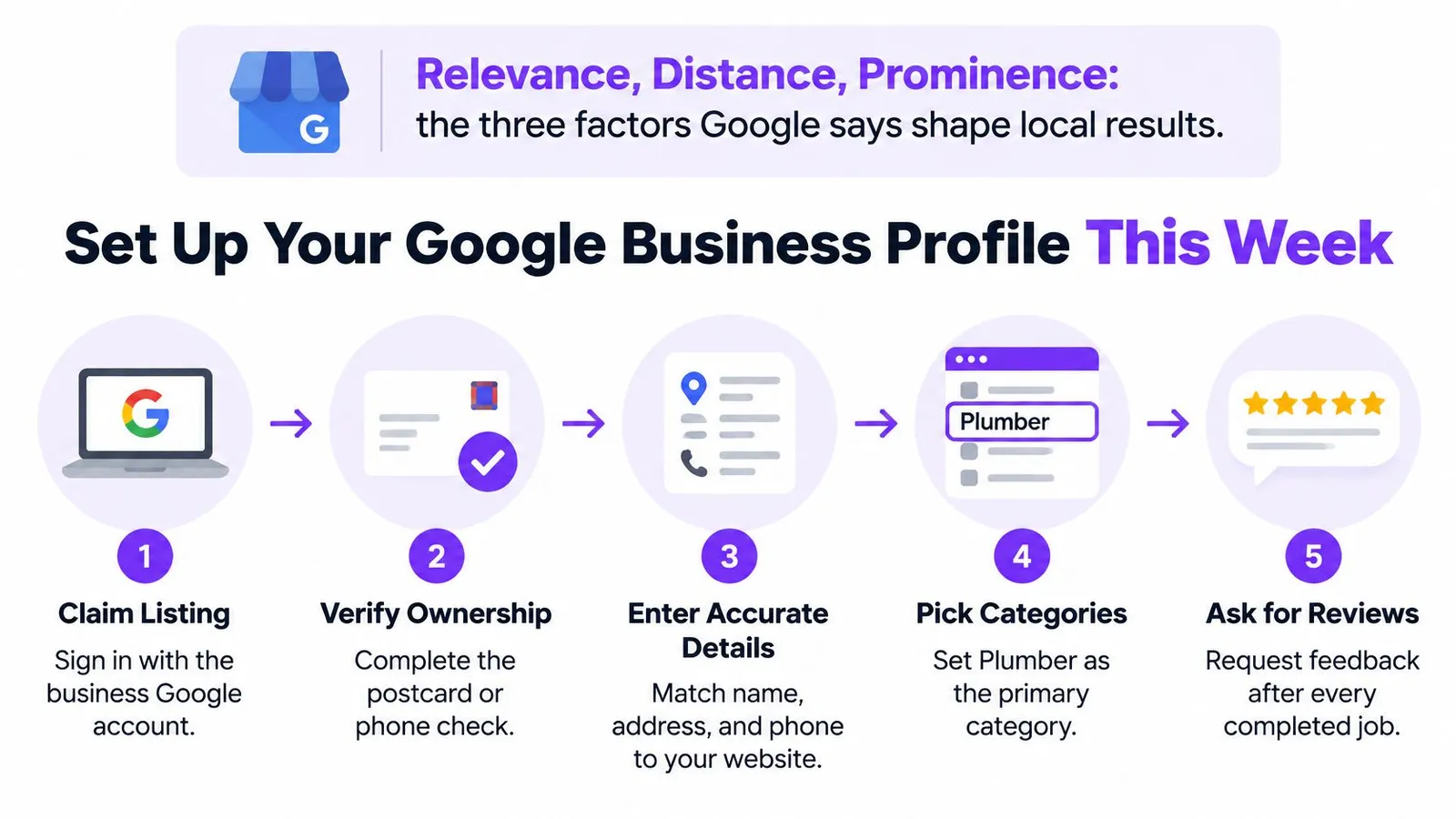
A healthy profile is complete, accurate, and matched to the jobs you want more of. Check it from a phone, too. Make sure the phone number works and the service details are easy to read.
Build Service Pages for Each Way Customers Search
One generic “plumber” page can’t answer a burst-pipe call at midnight and a water-heater replacement question equally well. Give each type of search a page that fits what the customer needs to decide.
| Search Type | Example Query | Page to Build | Commercial Value |
|---|---|---|---|
| Emergency | burst pipe repair near me | Emergency page with a click-to-call button and response area | Highest urgency, often a same-day call |
| Repair | slab leak repair | Problem page explaining signs, the visit process, and the next step | High, depends on what the visit finds |
| Replacement | water heater replacement cost | Replacement guide with options, timelines, and financing details | High-ticket job, longer decision |
| Maintenance | drain cleaning in [city] | Service area page with maintenance plan details | Steady repeat work |
| Commercial | commercial plumber in [city] | Commercial page with licensing, insurance, and project types | Larger jobs, longer sales cycle |
Start with the three jobs that bring you the most work now. Build those pages first, then use calls and booked jobs to decide what to add. If you need help matching customer language to page topics, use this guide to do local keyword research.
What a useful service page includes
Name the job in the page heading. Put your phone number near the top, with a tap-to-call option for someone reading on a phone. Explain what a visit involves, how urgent calls are handled, and what the customer should do next.
Include proof you can stand behind. That might be your licensing, insurance, or warranty details if you have them. A short FAQ can address real questions, such as how long a repair usually takes or what affects the cost. Don’t promise an exact result when you can’t know what the technician will find.
Town pages need local value, too. Build one for each town you genuinely serve, and include relevant details such as common building types or access issues. Don’t copy the same text and swap in a different city name. A page should help someone in that place, not just add a place name to your website.
Keep the business name, address, and phone consistent with your profile. And don’t create pages for places you don’t serve. The best page is the one that matches a real job, answers the customer’s next question, and makes it easy to contact you.
Turn Reviews and Fast Replies Into Booked Calls
A call comes in at 4:15 p.m. while you’re under a sink. By the time you wipe your hands and check the phone, the caller has already booked someone else. In local search, the plumber who answers first usually gets the job.
Research on lead response backs this up, though it comes from B2B sales rather than the trades. In a study reported by Harvard Business Review in 2011, companies that tried to contact a lead within an hour were nearly seven times as likely to qualify that lead as companies that waited longer. Plumbing customers are not sales leads, and they rarely wait that long. A homeowner with a leaking water heater works down the list until someone picks up.
Reviews decide which name gets that call. BrightLocal’s 2025 Local Consumer Review Survey found that consumers are far more willing to use a business that responds to all of its reviews, and that respondents commonly check reviews on more than one platform before choosing. So don’t treat reviews as a Google-only task, and don’t reply only when someone complains.
Keep a routine you can hold during a busy week:
- Ask after the job is finished. Send a short text with a direct review link while the work is still fresh in the customer’s mind.
- Reply to every new review. Thank the customer for a specific detail, such as the repair or the technician’s communication. A short, personal reply beats a copied line that says nothing.
- Handle complaints calmly. Acknowledge the concern, offer a direct phone line, and keep the public reply brief. Don’t argue about the job in a review thread.
- Check your other profiles. Respond on the other sites where your business appears, at the same standard you hold on Google.
Keep the phone rule simple: someone answers, or the caller hears back quickly by call or text.
When nobody on your crew can pick up, a plumbing answering service can take the call, capture the job details, and share quotes from your plumbing price book with callers who ask about cost before they book. A fast response only counts if it happens every time, including at 4:15 on a Friday.
Never offer discounts for reviews or post fake ones. Both break platform rules and erode the trust you spent years earning. For a broader routine covering reviews and public feedback across your profiles, Dekodi’s web reputation check lays out a weekly process. Then measure the result the same way you measure everything else in your marketing: booked calls and jobs won.
Get Found by AI Search Tools Like ChatGPT
When someone asks an AI tool who can fix a burst pipe nearby, why does it name one plumber and not another? No one can guarantee a mention. These tools change often, and a business can’t control which providers appear in an answer.
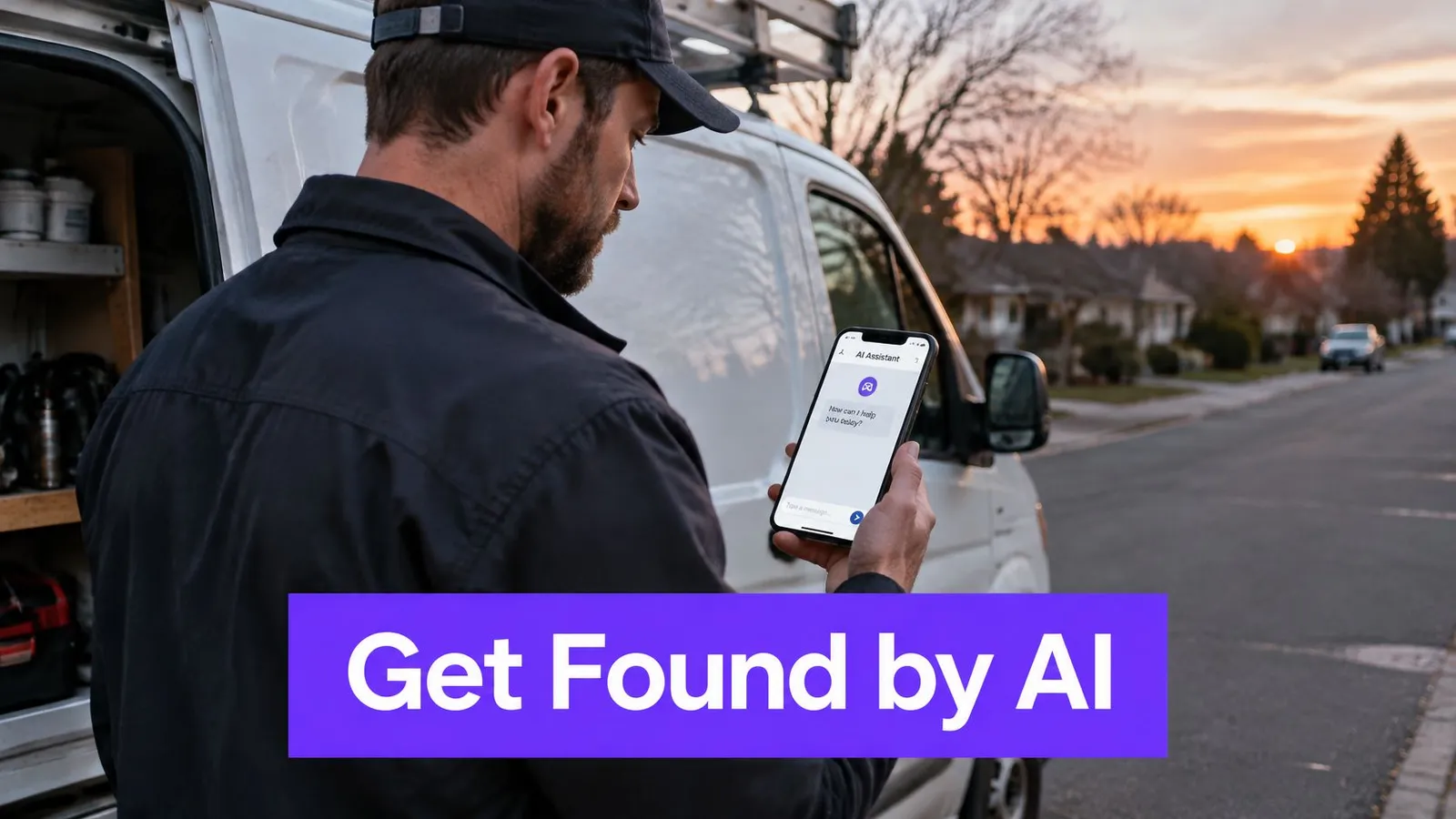
Some customers now see an AI summary before the usual list of websites. They may get a quick answer without clicking a site or a map listing. How often that happens on local searches is still being measured, and the numbers vary by study. Hashmeta’s local AI search analysis looked at a set of local queries in Q2 2025 and reported AI Overviews on 68% of them, while the traditional map-based local pack appeared on 39%. Those are two different features counted on the same searches, so one doesn’t replace the other. The practical read: AI answers show up often enough on local queries that you should know what they say about your company.
There is no special phrase that makes an AI name your business. The tools pull from the same signals you already build: consistent details, clear service pages, and reviews that describe real work. Treat each AI question the way you treat each search type. “Emergency plumber near me” and “water heater installation cost” are different jobs, and the pages answering them should be different too.
- Keep business details consistent. Your name, phone, hours, service area, and services should agree across your website and business profiles.
- Answer practical questions on service pages. Explain safety, urgency, licensing, price ranges, and availability in direct language.
- Ask for specific, honest reviews. A review that describes a water-heater replacement in a named neighborhood gives these tools more to work with than a generic compliment.
- Check what customers see. AI summaries may show fewer providers or leave out an obvious phone button. Don’t assume the customer sees the same contact options you do.
Run a simple monthly check. Ask an AI tool three questions your customers ask, such as who handles a burst pipe nearby or whether your company replaces water heaters. Note which businesses it names and what details it repeats. Then fix gaps in your own listings and pages rather than publishing generic posts and hoping for a mention.
A mention only matters if it turns into a call and a booked job. Count those the same way you count everything else.
Track Booked Jobs Before You Spend More
Search type leads to a call, then a booking, then an average ticket, a close rate, and finally gross margin. That chain tells you whether search visibility is producing work that makes sense for your business.
| Metric | Where to Find It | What It Tells You | Watch For |
|---|---|---|---|
| Calls from your Google Business Profile | Profile insights or call tracking number | Which listing brings phone calls | Many calls that never book |
| Direction requests | Profile insights | Interest from nearby people who may visit | Requests from outside your service area |
| Form fills and page calls | Call tracking or form tool | Which service pages drive contact | Spam forms or the wrong jobs |
| Booked jobs | Booking calendar or job software | Which searches turn into work | Bookings that are never confirmed |
| Average ticket | Invoices | How much each search type is worth | Emergency and install jobs mixed into one average |
| Close rate | Estimates compared with booked jobs | How well your follow-up converts | Slow replies lowering the rate |
Rankings can point you toward a visibility problem, but they don’t tell you whether the calls are worth your time. A top result that attracts requests for work you don’t do can fill the phone log without filling the schedule. Track emergency repairs separately from high-consideration installations. The same call count can represent very different business value.
Start with a manageable setup. Use a call tracking number on key pages or a call tracking tool, and record where each booking came from in your booking calendar or job software. Once a month, compare calls with booked jobs. Check which page or listing brought the calls, whether the customer’s job fit your services, and whether the estimate became confirmed work.
If your numbers are scattered across four apps, nobody may have time to read them. That’s the Patchwork Tax again. A smaller set of connected tools is useful only if it answers the question you care about: which searches bring the jobs you want? For a related example of connecting search marketing to business outcomes, see Dekodi’s guide to PPC for roofers.
We set the outcome and measures first, fund the tools needed, then keep the work tied to one scoreboard.
Dekodi connects local visibility, trust, and lead follow-up to the plumbing jobs you want to book. Visit Dekodi to book a free 30-minute walkthrough, with no pitch or pressure, and leave with a clear map either way.
What to do next
See what search and AI say about your business today.
Get My Answer AuditGet Signals every Monday
The week's most useful stories in AI, search and marketing, what they mean for your business, and one thing to do about it.