Published on
Written by
Dekodi Team
Monthly retainers most often fall between $501 and $1,000, one-time projects most often between $2,501 and $5,000, and hourly work between $75 and $100 an hour. The final number depends on scope.
You've got a proposal open, another provider waiting for an answer, and no clear way to compare them. One promises more visibility. Another lists technical tasks. Neither makes it obvious what you'll receive, what you'll still have to do, or whether the website bill is included.
That's a fair frustration. When you ask how much does search engine optimization cost, you need a funded plan for getting found by the right customers, not a mysterious monthly charge. The useful comparison is what work your money funds, who carries it out, and what customer activity you'll measure.
Table of Contents
What SEO Pricing Models Mean for Your Budget
An owner receives a monthly SEO quote with no work list attached. Is it fair? There's no honest way to tell yet. A price without scope is just a number wearing business clothes.
SEO is the work of helping search engines find, understand, and present your business's pages. You're paying for that work, not purchasing a reserved place in search results.
The opening ranges reflect the most common pricing bands in the Ahrefs provider survey, updated in August 2024 and summarized in the WE pricing guide. They're market reference points, not a menu every business should order from.
Match the billing model to the job
A monthly arrangement makes sense when someone needs to keep checking the site, updating information, publishing useful pages, and responding to performance changes. A defined project makes more sense when you can name the problem and the finish line.
Hourly help can be useful when you already have someone who can implement changes. Paying for advice doesn't mean you've paid for the fix.
SEO pricing models compared by what you buy
Pricing model | What you buy | Best fit | What to watch |
|---|---|---|---|
Monthly retainer | Ongoing optimization, monthly reporting and recurring changes | A business that keeps adding pages, listings and reviews | A fee that never names the work it covers |
One-time project | A defined deliverable such as an audit, technical cleanup or migration | A business with one known problem to fix | Follow-up work quoted separately after the project ends |
Hourly billing | Advice, short audits and small tasks billed as used | An owner who needs a second opinion or one fix | Hours that add up with no cap or written summary |
An audit is an inspection, not a repair. If a provider delivers a document explaining what's wrong, someone still has to make the changes. Ask whether implementation and testing are included before deciding that the project price looks attractive.
For hourly work, request an estimate, an approval limit, and a written account of what changed. For recurring work, ask what happens during a quiet month and how priorities get selected.
Practical rule: Choose the pricing model that fits the job you need done, not the lowest headline number.
A bounded cleanup followed by lighter maintenance may suit you better than a large ongoing commitment. Equally, repeatedly buying isolated fixes can cost more effort than funding a connected program.
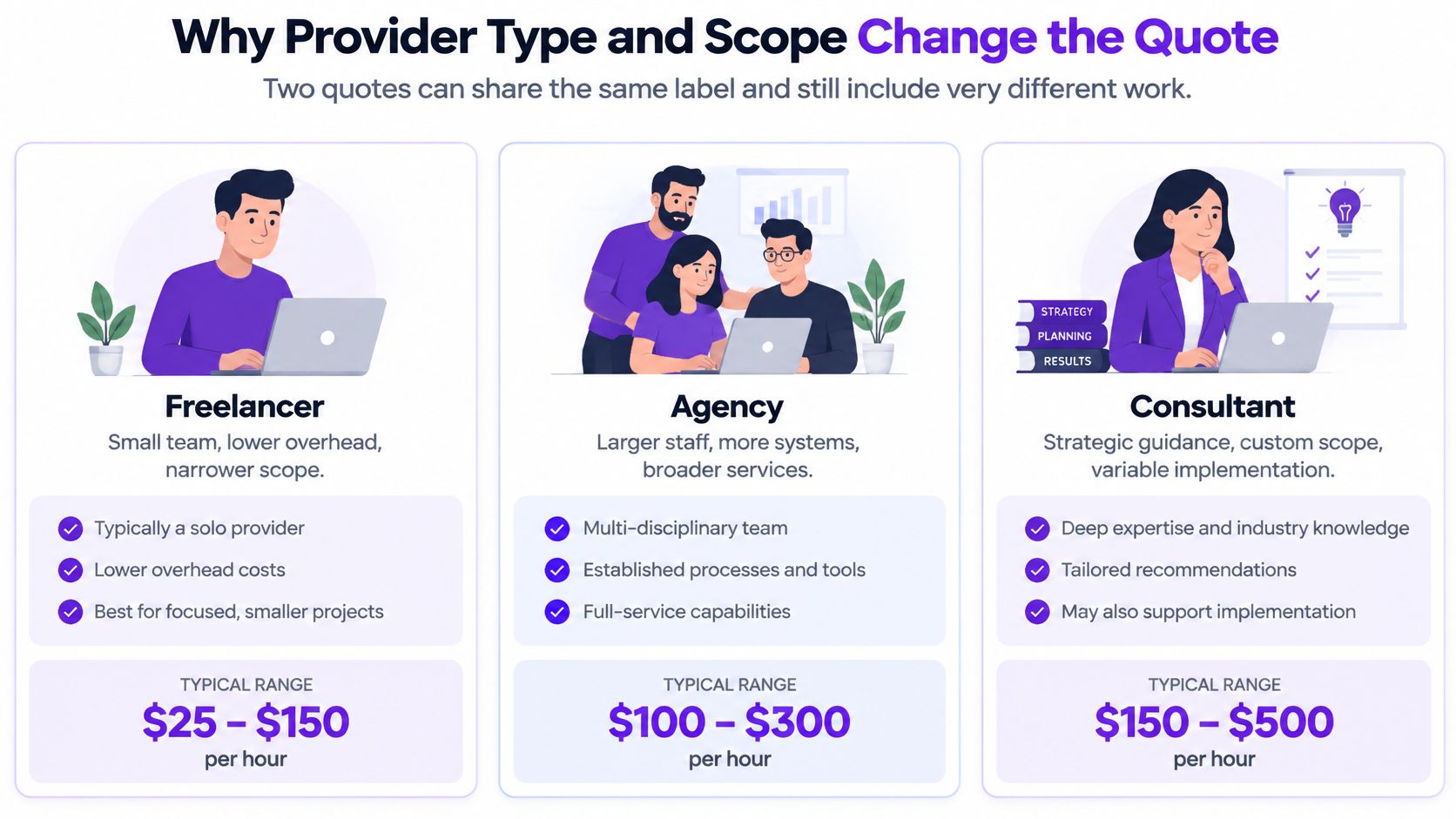
Why Provider Type and Scope Change the Quote
Two proposals can both say SEO management and still describe different purchases. One person might be doing the work directly. Another provider might assign specialists, a project manager, and an account contact. A consultant might recommend changes without implementing any of them.
None of those arrangements is automatically wrong. The right fit depends on who needs to carry the work.
The commercial publisher The HOTH's SEO pricing summary compares freelancers, agencies, and consultants and reinforces why provider labels alone don't make quotes comparable. Treat market benchmarks as direction, not proof that a particular proposal is fairly priced.
The staffing differences are useful to understand before you compare the totals.
Compare responsibility, not business cards
A freelancer may offer direct access to the person editing your pages. That can work well for a narrow assignment. Ask who covers development, writing, and reporting when those skills fall outside that person's role.
An agency may bring broader capacity. You should still know whether your fee funds hands-on implementation or mostly coordination.
A consultant can help your existing team make better decisions. But a strategy document won't fix a broken booking page unless someone has the access, time, and authority to act.
Use this scope test:
Work: What exactly will be done, and in what order?
Ownership: Who does each task, your team or the provider?
Completion: How will both sides know the work is finished?
A local maintenance assignment, a website rebuild, and a national campaign aren't interchangeable. If a redesign is involved, include SEO planning for the website redesign before approving design work, not after the new pages launch.
Fund the whole assignment
Our Start. Fund. Market. sequence begins with the outcome and scope. Then we identify the service work, software, website needs, and any separate media investment before execution begins.
That makes the comparison more useful: same assignment, clear responsibilities, visible exclusions. A cheaper proposal isn't cheaper if you must hire someone else to complete its missing pieces.
The Cost Drivers Behind Every SEO Quote
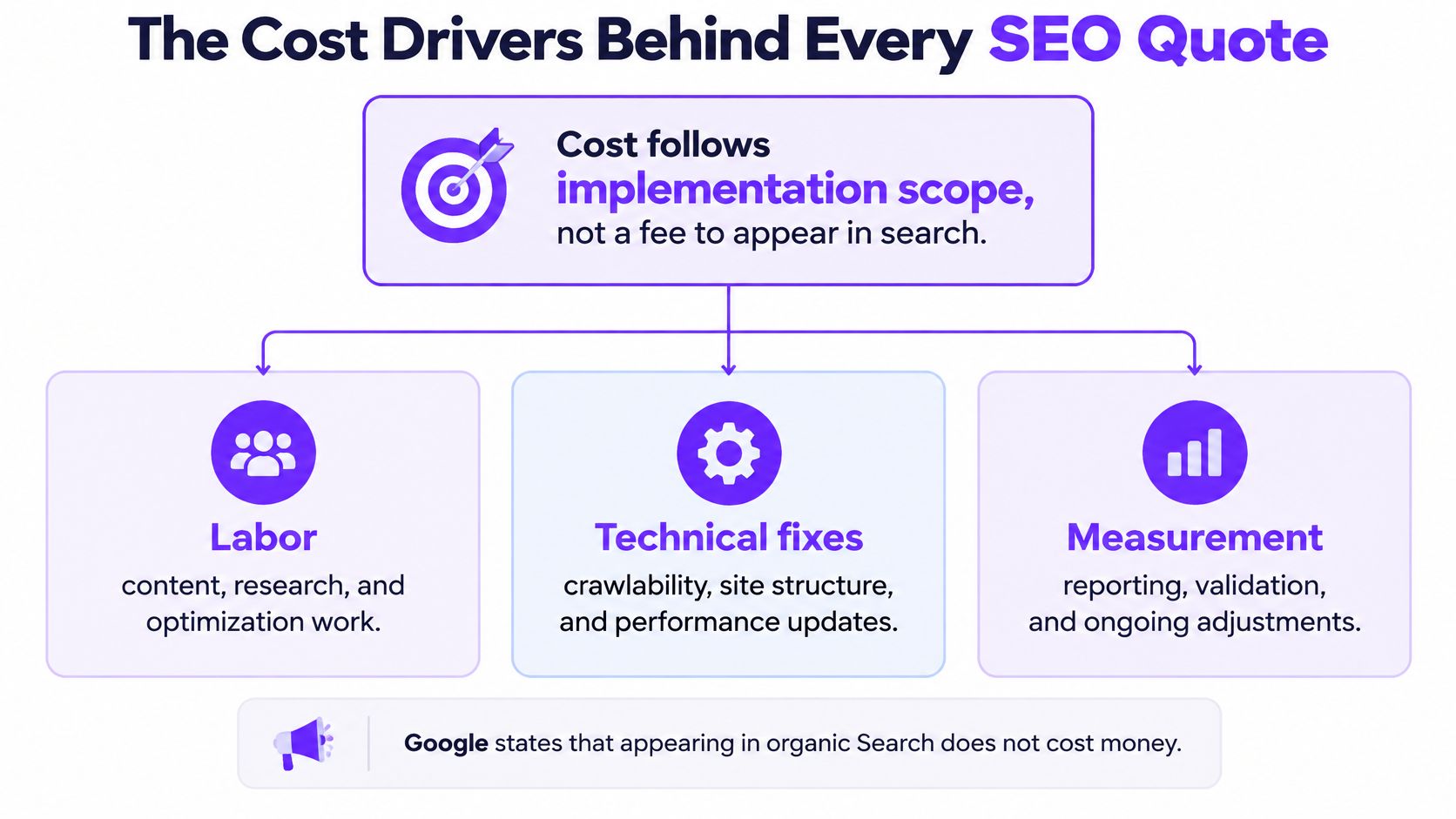
SEO costs depend on the work needed to reach a defined business outcome. Google's Search Essentials guidance states that appearing in organic Search doesn't cost money. The investment goes toward the people, technical fixes, content, measurement, and tools needed to improve visibility and turn it into customer activity.
A functioning site with accurate business information needs a different scope from a recently migrated site with broken redirects or missing pages.
Cost drivers and how they change the price
Cost driver | Lower-cost situation | Higher-cost situation |
|---|---|---|
Locations | One site serving one area | Several locations, each needing its own page and listing |
Website templates | One template with a few core pages | Many templates, duplicated location pages and JavaScript-rendered content |
Starting condition | Working site and an accurate Google Business Profile | Migration, broken redirects or indexing problems to fix first |
Content | Owner supplies answers, photos and facts | Provider writes, edits and publishes pages every month |
Reputation | Steady review requests from existing customers | Review workflow built from scratch across several platforms |
Measurement | Calls and forms tracked in one place | Conversion tracking, attribution and lead follow-up connected together |
Paid media | Excluded from the SEO fee | Quoted as a separate line item |
Establish the foundation before adding volume
First, confirm search engines can access the important pages. Check the XML sitemap, which lists pages you want search engines to discover. Test redirects from old addresses to their replacements, and canonical tags that identify the preferred version of similar pages.
Then check that calls and forms are recorded correctly. Publishing more pages before fixing access or tracking problems can expand the work without showing whether it is producing useful results.
For local businesses, Google's local ranking guidance identifies relevance, distance, and prominence as the main factors. Google also explains that links, review counts, and positive ratings can influence prominence.
That makes profile accuracy, location pages, review requests, and relevant local links parts of one plan. Use local keyword research to identify the services people search for, then scope pages around those services and the locations they serve.
Watch the Patchwork Tax
The Patchwork Tax is the time and budget lost to disconnected tools and vendors: overlapping software, repeated explanations, app switching, unclear reporting, and leads that go cold.
A quote that connects the work makes responsibilities and costs easier to assess. Ask which tools are included, which vendors are involved, who manages handoffs, and how leads are tracked. When separate invoices cover pieces of the same assignment, gaps in ownership can leave important work undone.
Why Rankings Alone Make a Weak Price Tag
A business can see its pages rise in search results and still be unsure whether SEO is bringing in customers. A rankings report shows visibility, but it does not show whether that visibility led to a qualified call, booking, direction request, or useful form submission.
A page can hold its position while the results around it change. Customers may find an answer directly, choose a map listing, or ask an AI tool for recommendations. Paying only for a position leaves you measuring something short of a business outcome.
A positive-looking report needs a customer-action check.

Separate upkeep from experimentation
Google's documentation on AI features explains that traffic from AI Overviews and AI Mode is included in Search Console's overall Performance reporting under the Web search type. Search Console is Google's tool for checking how your site appears in search.
Where AI-feature reporting is available, impressions describe how often links were shown, not whether someone became a customer. Ask which reporting is available for your property rather than assuming every AI appearance can be isolated.
The budget question is whether your information is accessible, clear, credible, and useful enough for search systems to present.
Maintenance SEO: Keep technical health, local profiles, reviews, and core service pages in order.
Adaptation SEO: Test direct answers to customer questions, first-hand expertise, consistent business mentions, and whether AI answers name the business.
AI changes how customers discover options. Accurate hours, clear services, and a working contact path still matter.
Use this video as another prompt for the questions you bring to a provider.
Make the test earn its next budget
Record a baseline of qualified calls, bookings, direction requests, and useful form submissions. Fund a limited test around high-intent local searches, meaning searches from people looking for a service they may buy.
Buy evidence you can act on, not a permanent commitment to a reporting format.
Agree on the outcomes that would justify expansion, the reporting period, and the date you'll review spending. Define attribution, meaning how you decide which marketing activity gets credit for an inquiry.
If visibility improves but qualified inquiries don't, investigate the offer, page, and contact process before buying more of the same work. Base the next budget decision on measurable customer activity, not a ranking or revenue promise.
What a Realistic Budget Looks Like for Three Businesses
A restaurant correcting outdated hours, a clinic opening locations, and a new shop preparing to launch need different first assignments. These are illustrations, not quotes. Set the budget around the work needed to reach a defined outcome, then decide what evidence would justify funding the next step.
A restaurant with an established location
Say a restaurant has a working website, but its holiday hours are wrong and its menu link leads to an old file. Start by correcting its Google Business Profile and making sure the hours, menu information, and useful photos are current.
After that, a maintenance arrangement can cover updates and a steady review-request routine. Track calls, direction requests, and reservations where tracking is available. Reassess the budget when the agreed work is complete and enough customer activity has accumulated to inform the next decision.
A clinic or service company adding locations
A growing operator needs accurate listings and a useful page for each eligible location. Begin with an inventory of addresses, services, contact details, page ownership, and tracking gaps.
Fund locations where the business can serve demand. Publishing interchangeable city pages may add work without clarifying what each location offers. Track qualified calls and bookings by location, then use those differences to decide where the next investment belongs.
For a trade business, plumbing search engine optimization shows how service pages and local intent can shape the assignment. The goal is to generate inquiries for work the team can accept.
A new shop or event launching quickly
A launch needs a usable brand and website before a recurring optimization package becomes the main purchase. Start with launch-ready pages, accurate opening details, and a tested contact or booking path.
Then fund a limited discovery test with a fixed review date. Measure qualified inquiries, registrations, or bookings that fit the business. Page views alone do not show whether the launch is producing useful demand.
For a small team with limited time, the provider should carry the task list while the owner approves consequential decisions, such as services, offers, and factual accuracy.
For every scenario, require:
A first deliverable: Something you can inspect and approve.
A customer measure: An action that matters to the business.
A review point: A date and evidence threshold for deciding what comes next.
How to Check an SEO Quote Before You Sign
Read the proposed work before you read the total. Look for crawl analysis, prioritized fixes, implementation time, validation, and reporting. Crawl analysis is an inspection of how search engines can move through your website; validation means testing whether the changes worked.
A clear proposal should explain the sequence. If the provider plans to write new pages while important existing pages remain inaccessible, ask why.
Use these checkpoints to keep the conversation concrete.

Read the exclusions as carefully as the promises
Quote check by item
Quote item | What a clear quote states | Red flag |
|---|---|---|
Scope | Named deliverables such as crawl analysis, fixes and reporting | Only ongoing SEO with no list |
Hours or activity | Hours or monthly tasks stated | No account of how time is spent |
Technical work | Audit and remediation shown as its own line | Technical fixes hidden inside the monthly fee |
Content | Who writes, edits and publishes, and how often | Content responsibility left unclear |
Reporting | Calls, forms, bookings and revenue reported | Reports that show only rankings |
Tools | Software costs listed separately | Tool fees added after signing |
Media spend | Ad budget shown as its own line | Ad spend mixed into the SEO price |
Exit terms | Notice period and ownership of files and accounts | No written exit terms |
Ask what happens after the audit. A satisfactory answer names who will make each approved fix, when it's scheduled, and how it will be tested. A list of recommendations without implementation ownership leaves you holding the project.
For content, ask what the provider needs from you. A useful answer might include a short interview, service details, approved photos, and factual review. It should also identify who drafts, edits, uploads, and approves the finished page.
Ask what the report will help you decide
Request a sample report before signing. It should distinguish completed work from customer outcomes and explain what the provider recommends next.
Revenue reporting needs realistic boundaries. If sales happen by phone or in person, agree on how staff will record them and how uncertain attribution will be handled. A provider shouldn't present incomplete tracking as exact proof.
Google's getting-started guidance notes that meeting technical requirements and best practices doesn't guarantee crawling, indexing, or placement. A guaranteed position is therefore a warning, not extra value.
Before signing: If you can't explain the quote to a colleague in a couple of sentences, ask for a clearer version.
Finally, confirm that your business controls its domain, website access, Business Profile, analytics, and customer information. Get the cancellation process and file handover in writing. You're buying professional help, not permission to keep using your own accounts.
Set Your First SEO Budget This Week
This week, check your Google Business Profile against what customers see. Review the hours, categories, photos, and recent reviews. Then write down the customer activity you already track, such as calls, form submissions, and booked appointments. Existing records, even a paper log, are enough to establish a starting point.
Give the first test a boundary
Set a spending limit, a review period, and a date to assess results against those customer actions. Separate initial repair work from ongoing upkeep so you can see what each part of the budget covers.
More options get attention. Clear options get decisions. Fund connected work against a defined outcome, rather than paying for a list of deliverables or a ranking target that can shift as search results change.
Dekodi Group connects project analysis, investment planning, and marketing execution through its Start, Fund, and Market sequence. Visit Dekodi to share your outcome and scope, and see how that sequence could apply to the SEO work your business needs.