Published on
Written by
Dekodi Team
You ask what a TV spot costs, get a number that sounds manageable, and start thinking about the commercial. Then the production quote arrives. Then the airtime agreement mentions a monthly commitment. Tracking responses turns out to be another conversation.
That's frustrating, and it doesn't mean you missed something obvious. You were quoted a piece of the purchase, not the whole campaign. The useful question is what you'll spend to bring in customers you can count.
Table of Contents
What a TV Ad Really Costs in 2026
The cost of a TV ad is a campaign budget, and the spot price is usually its smallest line. Before you approve anything, split the quote into three bills: what it costs to make the commercial, what it costs to run it, and what it costs to learn whether it worked.
Typical TV ad cost ranges by budget line
Budget line | What it covers | Typical range |
|---|---|---|
Basic local video production | Simple local commercial for a small business | $1,000 to $5,000 |
Professional production, local or basic | Entry-level traditional TV work | $1,500 to $10,000 |
Professional production, regional | Multi-area shoot with more crew | $10,000 to $50,000 |
Professional production, national mid-level | National-quality shoot | $50,000 to $200,000 |
Professional production, premium national | Top-tier national work | $200,000 to $500,000 |
Local airtime, small markets | Price per 30-second spot | $200 to $1,500 |
Local airtime, top-10 markets | Price per 30-second spot | $5,000 to $50,000 or more |
Local station minimum commitment | Monthly minimum spend | Set in the station's written agreement |
Measurement and optimization | Tracking calls, leads, visits or sales | Scoped to the tracking you choose |
Adwave's small-business TV spending guide lists roughly $1,000 to $5,000 for basic local production and $200 to $1,500 per small-market spot, against $5,000 to $50,000 or more per spot in top-10 markets. Playcut's commercial production cost guide lists $1,500 to $10,000 for local or basic work, $10,000 to $50,000 for regional work, $50,000 to $200,000 for national mid-level work, and $200,000 to $500,000 for premium national work.
Use these ranges to sanity-check the quotes you request. No single TV ad price exists, and production categories overlap because a "basic commercial" means different things to different shops.
A floor isn't a launch budget
Add the lowest basic-video figure to the lowest small-market spot figure and you get an illustrative floor of $1,200. That buys one commercial and one airing. It leaves out the monthly minimum, any fees, and any way to count the customers the spot produces.
Don't add the production rows together. They're alternative levels of work, and only one of them belongs on your invoice. Pick the scope that matches the commercial you need, then confirm what's excluded from that price.
A station minimum changes the arithmetic further. You might be pricing a $200 spot while the agreement commits you to a monthly spend many times larger. Get the minimum, the cancellation terms, the payment schedule and the included placements in writing before you compare offers.
Budget rule: A low entry price only helps when you understand the commitment attached to it.
Build your working budget around the full launch plus enough airtime and tracking to judge results. The parts add up, so a cheap spot can still become an expensive campaign.
Three Bills Behind Every TV Ad
A station rep quotes you a spot price, and it looks manageable. Then the production invoice arrives. Then someone still has to deliver the finished file, track the calls it generates and report back. The spot you were quoted is usually the smallest of three separate bills.
A television campaign works like a catered dinner. One vendor cooks the meal, another rents the room, and a third manages the guest list and counts who showed up. Paying the cook does not cover the room.
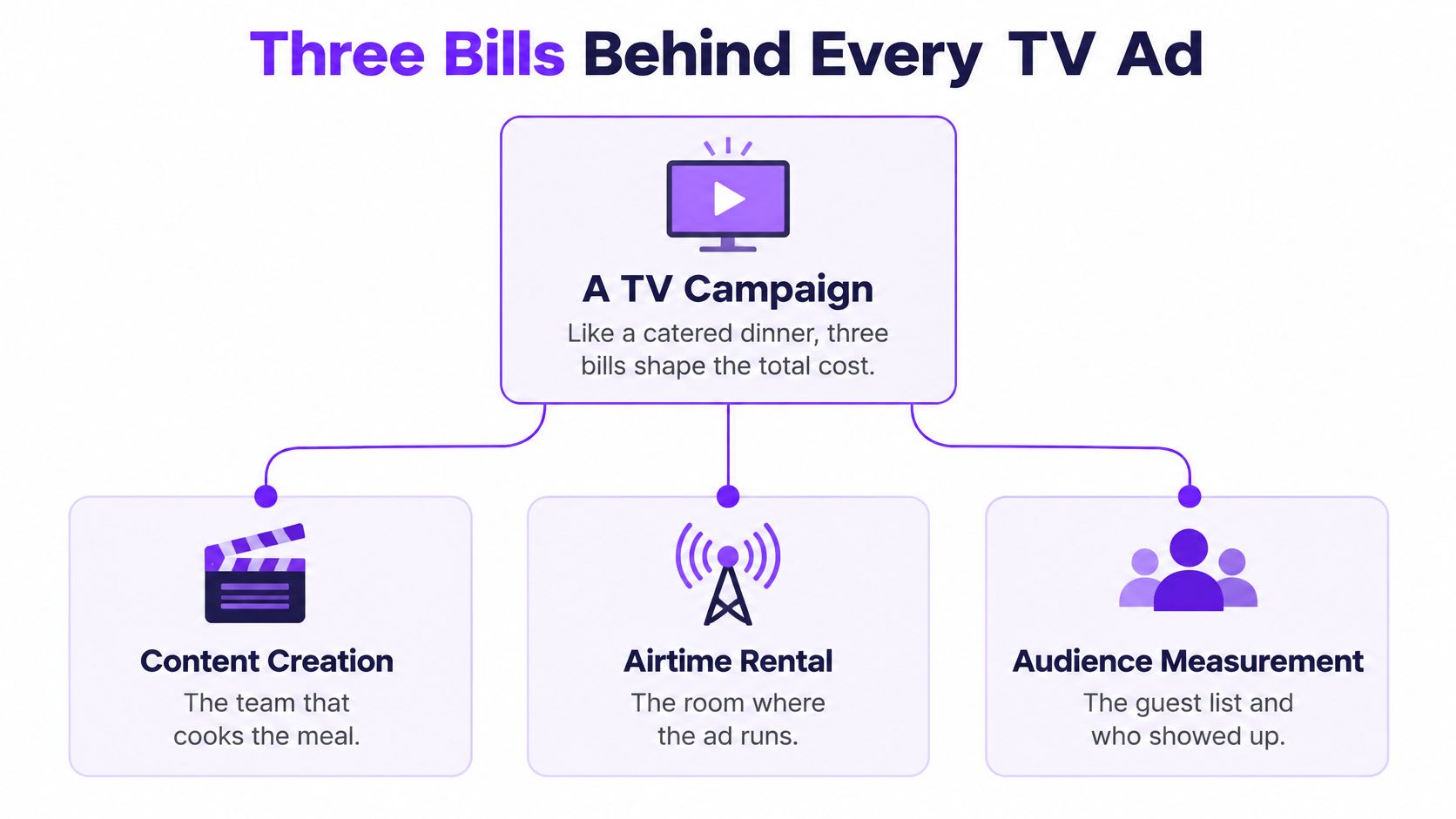
Production buys the commercial
The first bill pays for creating an ad the station can air: the idea, the shoot and a finished file in the right format. That purchase ends when a usable commercial is in your hands.
Delivery isn't the same as ownership. Ask whether you receive only the finished video or also the raw footage and editable project files. Confirm who can make changes later, and what a re-edit costs if your offer or phone number changes.
Airtime buys access to an audience
For ordinary commercial advertisers, airtime has no published rate card. Prices come out of negotiation between the sponsor and the station, and the station keeps discretion over which advertising it accepts.
That is why two quotes that look similar can price out differently. The station, the program, the time of day, the market, audience demand and the package terms all shape what you are buying. Get each of those variables in writing before you compare one quote against another.
Support buys delivery and accountability
The third bill covers the work around the ad. Trafficking means getting the correct commercial to the correct outlet with the right instructions. Measurement means connecting campaign activity to calls, inquiries, visits or purchases.
Ask who handles rejected files, schedule changes and reporting. A package with airtime included can still leave those jobs with you.
The Patchwork Tax starts here. Each purchase looks reasonable on its own, but separate vendors, barely used tools and repeated handoffs create a total nobody planned. You lose hours switching between systems, and inquiries can sit unanswered because nobody owns the next step. Naming one owner for each bill closes most of that gap.
Before approving a quote, sort every charge into three columns:
Production: What will be created, delivered and licensed?
Airtime: Where and when will it run, and on what terms?
Support and measurement: Who manages delivery, tracks responses and recommends changes?
More options get attention. Clear options get decisions. A quote that resists this sort is showing you where the surprise costs will hide.
What Moves Production Cost From Basic to Premium
Why does a commercial of the same length cost so much more to make somewhere else? Usually, the answer sits in the work behind the camera, not the running time.
A straightforward shoot at your business is a different assignment from a scripted story involving travel, a larger cast and complicated scenes. Both can produce a short commercial. They don't require the same resources.
Follow the work in order
Concept and script come first. A clear offer, a believable reason to choose you and an obvious next step are more useful than a clever idea nobody remembers correctly. Settle those before booking the shoot.
Pre-production follows. That's the planning work: casting, location scouting, schedules, props, permissions and shot lists. Changing the concept after those arrangements are made can mean paying to organize the job again.
The filming budget reflects crew, equipment, locations and time. A controlled shoot in your own space limits moving parts. Multiple cities, larger casts and scenes that need special lighting or staging add work.
Talent and usage rights: Confirm where the performers' work can appear and how long you can use it. National permission is a different purchase from limited local use.
Editing and graphics: Ask what's included in the edit, captions, color correction, sound finishing and motion graphics.
Music and voiceover: Check that permission covers every intended channel, not just the original television placement.
Revisions: Name the person who approves changes and collect feedback before sending it to the editor.
Buy useful versions, not just a finished file
Plan the other uses before filming. The same concept may support shorter television edits, streaming placements, social video and a website version. But a horizontal commercial doesn't automatically become a good vertical ad by cropping the edges.
Ask the producer to capture the framing, extra footage and clean audio those versions need. Confirm the deliverables in the quote rather than assuming an editor can produce them later without additional work.
A reusable commercial is valuable only if you have the files, formats and rights to reuse it.
Production averages need caution. Playcut discusses a historical industry survey that was later discontinued, which is a poor foundation for treating an old average as a present-day small-business budget. The production tiers are more useful as scope categories than as a prediction of your invoice.
Spend more when the extra work serves the message, the audience or the commercial's useful life. Don't pay for complexity just because television feels like it should be elaborate.
A quote that doesn't list line items isn't yet a budget.
Premium Benchmarks and What Audience Reach Buys
The same commercial length can come with very different airtime prices. Nielsen's advertising and audiences report reported that an average U.S. 30-second prime-time spot across broadcast and cable cost approximately $7,800 in 2013, while broadcast-only prime-time inventory averaged nearly $75,000.
Those are historical benchmarks, not current quotes. Their value is the contrast: grouping broadcast and cable together produces a very different number from looking at broadcast alone.
You're paying for the audience around the ad
A sought-after program offers access to an audience that other advertisers also want. The available commercial breaks are limited. The station isn't selling seconds of video playback.
For a local owner, the practical distinction is reach versus relevant reach. A large audience can be useful, but people outside your service area don't become better prospects because the program is popular.
Compare the geography of the audience with where you can deliver, install, serve or sell. Then check whether the people reached resemble the customers you want.
Buying question | What it helps you judge |
|---|---|
Where do viewers live? | Whether you're paying to reach people you can serve |
Which viewers match your customer? | Whether broad exposure includes likely buyers |
What makes this placement scarce? | Whether the premium has a useful business reason |
What happens after someone sees it? | Whether attention has a clear path to action |
The exceptional case isn't your rate card
At the far end, USA Today's 2025 Super Bowl advertising report puts a national 30-second spot at $37,500 for the first game in 1967 and approximately $7 million for the 2025 broadcast.
That's an example of concentrated attention and scarce inventory, not a sensible planning average for a local business. It also isn't a hard ceiling on what advertisers might pay.
A regional or local buy can offer a lower absolute investment and better geographic relevance. A national event offers enormous exposure, but exposure outside your business model isn't automatically valuable.
What audience are you paying to reach, and does the price match it?
Turning an Airtime Rate Into Cost Per Customer
CPM = total media spend ÷ estimated impressions × 1,000.
CPM means cost per thousand impressions, or what you pay for a thousand estimated ad exposures. An impression is an exposure, not necessarily a different person or a future customer.
Keep the audience estimate beside the quote while you compare placements.

Compare the denominator, not just the price
Say you're comparing an inexpensive daytime placement with a pricier evening program. Use your actual quotes and each station's estimated impressions in the formula. The daytime spot is only the better media value if its lower price holds up after you account for the audience delivered.
Also check what the estimate includes. Are both sellers describing the same geography, audience group and reporting period? A calculation can be correct while the comparison is wrong.
The FCC's candidate advertising rules distinguish advertising by categories such as length, class and period. Those legal rules aren't a commercial buyer's discount entitlement, but they underline why placements need matching specifications before you compare them.
Translate exposure into a business decision
Write down the complete campaign quote, estimated impressions and gross profit from a typical customer. Gross profit is what remains from the sale after the direct cost of providing the product or service.
Then answer these questions:
Customer value: What gross profit does a typical new customer contribute?
Conversion: Of the qualified inquiries you receive, how many become booked customers?
Repeat purchases: Are you evaluating the first sale or a documented pattern of repeat business?
Frequency: How often will the intended household see the ad, and how will you check that delivery?
Total campaign cost ÷ gross profit per new customer gives you the customers needed to cover that investment. Round up, and remember that covering the campaign isn't the same as covering every business expense.
This supporting video belongs alongside the worksheet, not in place of your own figures.
For a service business, the same discipline applies to evaluating paid search for roofers: an inquiry isn't a booked job, and a booked job isn't automatically profitable.
A practical test can use a shared creative concept across local television, connected TV, social video and retargeting. Retargeting means advertising again to people who previously interacted with your business. Keep the offer consistent and record qualified leads and booked customers, not just exposures.
Cheap impressions that don't produce useful responses are still expensive.
Linear TV, Streaming and Which Channel Fits
Should you buy the broadcast slot, streaming inventory, or a mix? Start with the people you need to reach, not which seller has the most attractive presentation.
Linear TV follows a scheduled broadcast or cable lineup. Connected TV, or CTV, delivers internet-connected television viewing through devices and apps. They can appear on the same screen without offering the same buying options.
Match the channel to the job
Nielsen's 2025 connected TV analysis reported that streaming represented 43.8% of total U.S. TV time in March 2025, while linear TV delivered 86% of TV ad impressions in the first half of 2025; CTV's impression share rose from 11.49% in January 2025 to 16.49% in June 2025.
Those measures describe different things and reporting periods. Viewing share isn't advertising share, and a monthly figure shouldn't be treated as directly equivalent to a half-year figure.
Linear TV compared with connected TV
Criterion | Linear TV | Connected TV (CTV) |
|---|---|---|
Main strength | Broad reach across large audiences | Addressable targeting and conversion measurement |
Share of TV ad impressions | 86% in the first half of 2025 | 16.49% in June 2025, up from 11.49% in January 2025 |
Typical cost pattern | Negotiated placement or package price shaped by market, program and timing | Audience and inventory-based pricing; request all platform, data and service fees |
Best fit | Wide service areas and broad awareness | Narrower audiences and measurable response |
Streaming isn't automatically cheaper. A targeted placement can cost more per exposure while wasting less of your budget on people you can't serve. It can also disappoint if the targeting, inventory or measurement doesn't match the sales pitch.
Use the same decision criteria
Score each proposal against:
Audience: Does the seller reach your likely buyers?
Service area: Can you buy the geography you serve?
Budget: What's the complete commitment, including support?
Frequency: How will the seller manage repeated exposure?
Privacy: What information supports targeting and measurement, and what permissions apply?
Outcome: Can you evaluate qualified inquiries, bookings or another useful result?
A wide service area with broad awareness goals often makes linear worth considering. A narrower audience with a defined response goal can make CTV worth testing. Neither choice removes the need for a clear offer and a working follow-up process.
Coordinate any supporting Facebook page advertising with the television message rather than creating an unrelated promotion. Customers shouldn't need to figure out whether the ad and the page describe the same business.
Ask every seller to answer the same criteria before comparing prices side by side.
Ask for a Line-Item Budget Before You Approve Any Buy
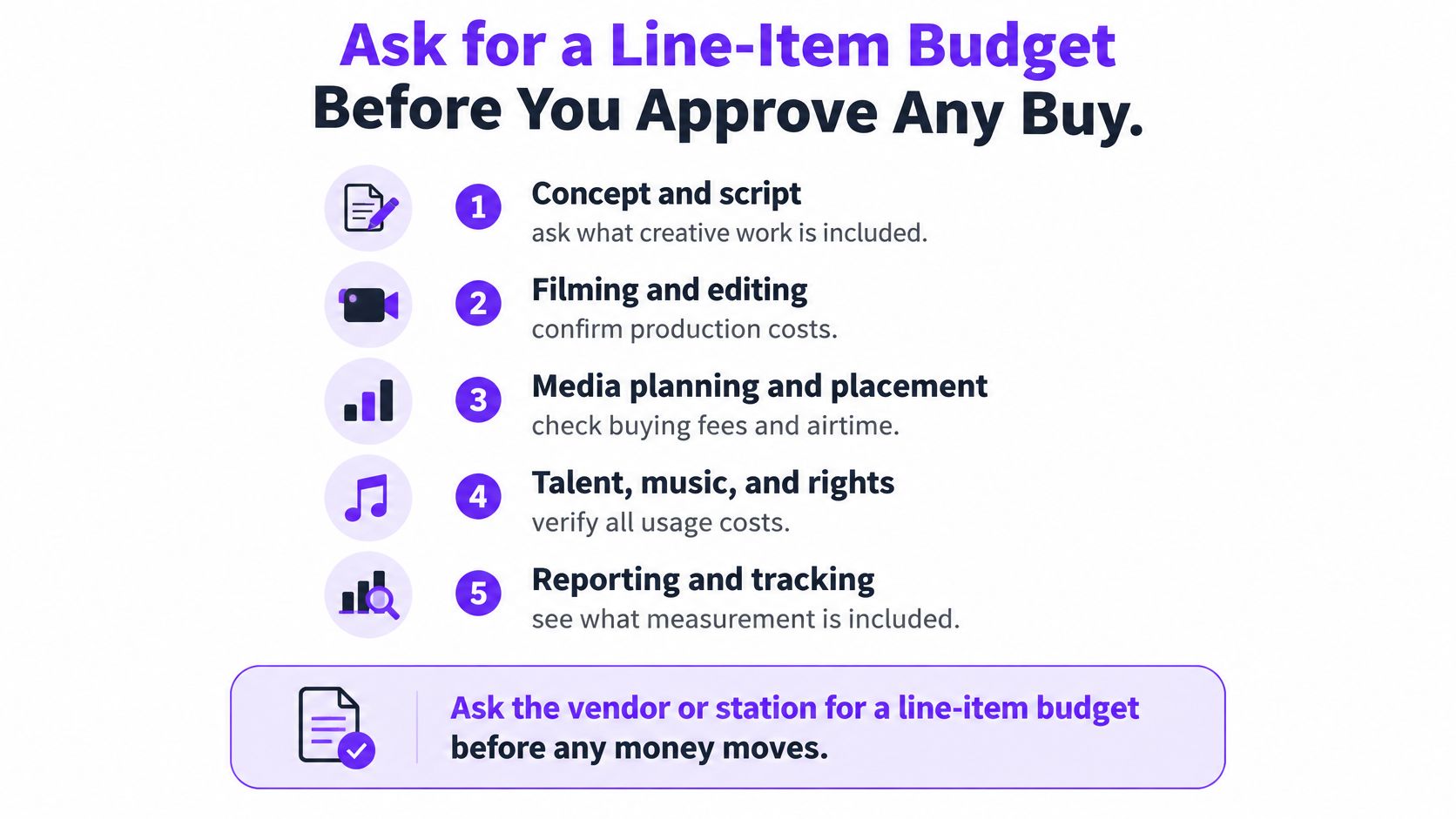
A cheap spot turns expensive the moment the missing line items surface. Production, airtime and measurement are three separate bills, and a quote that covers only the second one leaves the other two to appear after the money is committed.
So before any money moves, get the complete budget in writing. Put it in a spreadsheet you control. Mark each item as included, excluded or awaiting a quote.
That exercise beats collecting another headline price. It shows which proposal is ready to approve and which still needs a conversation.
Check the scope before the total
Concept and script: Name the creative work and approval process.
Filming and crew days: Confirm locations, crew, equipment and scheduling.
Editing and versions: List each required format and delivery file.
Talent and usage rights: Specify channels, geography and permitted usage period.
Music and voiceover licensing: Confirm what you may use and where.
Airtime: Name the station, program or time slot and placement schedule.
Minimum monthly commitment: State the required spend and exactly what it covers.
Agency or trafficking fees: Identify management, delivery and change charges.
Measurement and reporting: Name the tracking method, report and responsible person.
Use this checklist to keep the conversation focused on what's included.
Write down what would make the purchase worthwhile
Choose the result you need: qualified inquiries, booked customers or store visits during the campaign. Put your expected gross profit beside it, then divide the total campaign cost by that target result. The answer is your allowable cost per outcome, and it gives you a number to hold every proposal against.
Treat that figure as a filter rather than proof. It tells you whether the proposal deserves a test; the measured results tell you whether to renew.
If the commitment doesn't fit, postpone the buy. Lower-cash-cost visibility work, including free advertising sites, can fill the gap, as long as you account for the setup and maintenance time they still require.
You don't need to approve an incomplete quote just because the airtime is available.
The goal is growing predictably: knowing where customers come from and what it costs to earn their business. If the quote can't name the work, the commitment and the measurement, it isn't yet a plan.
At Dekodi, we use Start. Fund. Market. to define the outcome, show every dollar across services, software and ad spend before launch, and keep execution tied to measurable results. Contact us to map your production, airtime and measurement costs through that process before you commit to a buy.